Monday, November 13, 2023

Evening Primrose

Oenothera biennis

Connection to Spirit, Working with Spiritual Realms

The Evening Primrose originated in North America and grows throughout South America, Europe and some parts of Asia. The plant produces four-petaled flowers that are fragrant. The plant is best known to produce yellow flowers that are 2 inches across. Some plants produce flowers in pink, red, purple and white. Flowers are closed during the day and open at sunset, attracting moths and bats. Before flowers close in the morning, they attract bees, butterflies and birds.

Plants grow from 3 to 5 feet tall and about 2 feet wide. Because they self seed, plants tend to sprawl. Plants grow well in full sun or partial shade and like well drained soil. They are drought tolerant and deer resistant.

Evening Primrose seeds are used to make Evening Primrose oil, which is used for skin conditions, premenstrual syndrome (PMS) and menopause symptoms. Native Americans used the plant as a topical skin conditions such as bruises and inflammations. Leaves were ingested for sore throats. 

Flowers are used to make a flower essence that is suggested for use to treat emotions from early childhood. 

Evening Primrose flowers have four petals. The number four is associated with many divine properties: the four elements (air, earth, water and fire) and with the four directions (east, south, west, north). The elements and directions have application in shamanism, the path of direct revelation in the spirit world and way to connect with all of creation. In numerology, the number four is associated with the energy of the Archangels, who work with people continuously through messages, healing and in all things when asked.

Evening Primrose symbolizes working with spiritual realms for healing, providing loving messages from loved ones who have passed (mediumship), providing messages from guides, angels or brothers and sisters of the light (ascended masters) and light councils for messaging (channeling) or healing (Reiki and other hands-on modalities).

Those who identify with the qualities of Evening Primrose are also able to see things in the dark, meaning those places where lower energies reside. Those who work in spiritual realms can call that which is in darkness into the light, to send lower energies to the light or to remove lower energies so that people may live more fully.  

Evening Primrose are primarily or most commonly yellow.  Yellow symbolizes joy, and those who connect to spirit and who work with the spiritual realms experience the joy that spirit brings to all of us. 

The Evening Primrose Flower has also been called Common Evening Primrose, Evening Star, Sun Drop, Fever Plant, Hog Weed, King’s Cure-all or Cure All.  


Friday, June 23, 2023

Forget-Me-Not

Myosotis sylvatica 

Taurus

Angel energy, Angel symbolism

Forget-Me-Not is a flowering perennial plant that typically grows up to 5 inches in height with some varieties growing up to 1 foot tall. Plants bloom in spring or summer with clusters of small (3/8 inch across) blue flowers with five petals that have yellow centers. Some varieties of Forget-Me-Nots have white, yellow or pink flowers. The small flowers attract bees, butterflies and moths. 

Forget-Me-Not can be grown easily from seed and reseeds on its own. After one year, plants reach maturity and flower. Plants are easy to maintain; they like sun and part shade and tolerate heat and cold as well as wet soil. Plants are rabbit and deer tolerant. 

Plants are native to Europe and now grow in temperate areas all over the world. The Latin name Myosotis is from the Greek words mus and ous, meaning mouse ear. The plants have short pointed leaves that are similar to mouse ears. 

Forget-Me-Nots grow on riverbanks and in damp ditches, in meadows, in the woods, in rocky places in the mountains. Alpine Forget-Me-Not (Myosotis alpestris) - the official flower of Alaska, and Mountain Forget-Me-Not (Myosotis asiatica) grow at higher elevations in moist mountainous areas.

Forget-Me-Nots present us with a combination of very common and very unique characteristics.  Common attributes include being easily grown from seeds and easily reseeding itself. Also, plants are not particular about their growing conditions.

The flowers are fragrant in the evening and night, and are not fragrant during the day. Another unique characteristics is that the plants have true blue flowers. Less than 20 percent of plants have blue flowers. Blue is symbolic of the color of Archangel Michael, who brings us his energy, support and protection.

Flowers have five petals that surround a yellow center. The angelic meaning of the number 5 is that angels are bringing you messages, often of life changes. You can reflect on Forget-Me-Not flowers when you are in times of personal and professional change to encourage inspiration on the direction of your choices.

Forget-Me-Nots regenerate themselves, creating a continuous cycle of birth. Angel energy also is forever continuous and regenerates endlessly, being activated from the angelic realm or from our requests. 

If you have made a request that involves angels working on your behalf or for someone you care for, and you see Forget-Me-Nots, you will know that the angels have heard your message and a plan is in place for everyone's highest good.

Historically, myths were told about the flowers in relationship to a person "not forgetting" something or someone. Forget-Me-Not is used currently in association with remembering in many marketing ventures.


Saturday, August 6, 2022

Buttercup

Ranunculus 

Virgo

Youthfulness, Life Transitions

Buttercups include a wide variety of flower types that produce primarily yellow flowers. Some plants bloom in summer, and some varieties produce white, orange or red flowers. Buttercup flowers have five petals and have layers of air underneath the flower petals' surface that reflect light and create a shiny gloss. The flowers track the sun and will form a cup to gather solar energy for warmth on cold days.

Plants are perennials, with flowers blooming in the second year.  Buttercups bloom for about 10 years. Buttercup plants like to grow in moist sites and in temperate zones. Buttercups can be reproduced by seed and rhizomes. 

Buttercup leaves are poisonous to humans and animals.

Flowers have five petals, resonating with the energies of the number 5. That number brings in the concepts of positive live changes and making healthy lifestyle choices. You may chose to consider those topics to accelerate any positive life changes and choices underway.  

Buttercups have about a 10 year span for blooming, reflective of the timeline for childhood.  The petals of the flowers are illuminated, so combined with the blooming season, buttercups reflect to us the purity and joy of our earliest years on the Earth. The yellow color also suggests the joy associated with childhood and the joy and brilliance we can allow ourselves to feel throughout life. Buttercups bring to us the joy, energy and exuberance of all things youthful. 

Meditating on buttercups can help us bring in the aspects of youth we would like to manifest at any time of our lives. Think of how you would feel in a field of these lovely flowers, then think of the youthful traits you'd like to see in your life. And then allow yourself to feel those traits. 

Buttercups' luminescence also represents a connection to the world of small light beings such as fairies, who also shine their lights into our world. 

As buttercups have a defined span for blooming, they also emphasize transitions. Once blooming stops, the plants doesn't die but continues to grow and thrive without flowering. Each day is a new beginning and you can chose to start each day as a transition into the version of you that makes you happiest. 

If you are experiencing transitions in your life, buttercups remind us that some of life events represent endings while the strong foundation is in place to support continuing on and new beginnings. You can set your intentions for the new beginnings that best support your life goals and happiness.


Tuesday, February 15, 2022

Daffodil

Narcissus

Pisces, Aries

Rebirth, Forward thinking

Daffodils are perennial plants grown from bulbs. They like full sun or part shade and well drained soil. Daffodil flowers bloom once each year and, depending on the variety of plant and the climate, flowers last from 6 weeks to 6 months. Flowers grow on a single stem. The traditional flower is white or yellow, with some varieties incorporating orange and pink, and has six petals and a trumpet or bell shaped crown (corona). Leaves grow from the bulb and are long and narrow, growing up to 12 inches in height. 

Bulbs need a cold period to develop roots, with flowers blooming in late winter or early spring. This shows us that some ideas we have planted need time to grow, and when they have been elaborated or grown to a level of maturity, will bloom in their own time. After daffodils bloom, the foliage remain green or will slowly yellow for the next 4 to 6 weeks while the plants continue to create and store energy for the bulb for the next growing season. The leaves will die when the process is completed.

Daffodils as a whole are symbolic of ideas or of the potentials and possibilities available to us all. The Daffodil bulb provides the energy needed for rebirth which can be of a project, idea or relationship. An established Daffodil bulb blooms year after year. We can look to this cycle for the rebirth of projects, ideas and relationships important to us that need that fresh breath of air, or a fresh bloom of energy to carry it on. 

The daffodil flower is symbolic of forward thinking. People who enjoy this spring bloom are also those who are able to look into the possibilities or the potential of the future. They can observe what is and explore the possibilities of what is around the corner or a year or more out. They can project their ideas into the future to see what may happen, and almost seem to be receptors to future ideas that are percolating on the horizon.  

Symbolically, the number six, the number of petals on a Daffodil, relates to problem solving and balance. These attributes tie into the abilities to think through possibilities and to bring projects and ideas into new light. 

Daffodil is the birth flower of March, which has the zodiac signs Pisces and Aries. Daffodil is native to Northern Europe and is the national flower of Wales. Plants, bulbs and flowers are poisonous to people and animals. 


Wednesday, October 27, 2021

Holly

Holly

Ilex aquifolium

Cancer, Leo

Balance, Protection 

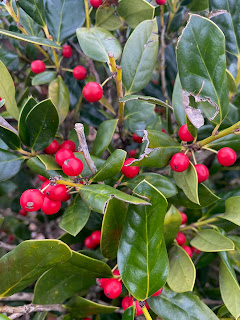
Holly is some 600 species of evergreen trees and shrubs that like to grow in tropical and warm areas worldwide. The plants like sun to part sun and well-drained soil. Some varieties can live to 100 years old. 

Historically, Holly has been gathered as a Christmas decoration and has been associated with the crown of thorns on Christ's head due to the spiky leaves. 

Holly plants are best known for their bright red berries that remain on the plants for up to 6 months and are an important source of food for birds in winter. Small mammals also eat the berries and leaves. Different varieties of holly produce berries in pink, blue, orange and white. Holly berries are poisonous to people and pets. 

Most Holly plants are dioecious, meaning they produce either male or female flowers. Female plants rely on nearby male plants to be pollinated, otherwise they will not produce berries. Only female plants produce berries. Male plants need to be within 50 feet of a female holly plant.

Holly is symbolic of balance - it takes a male and female plant for berries to be produced. The concept of male and female, each put on the end of a balanced scale, with provide balance with the concepts of the masculine and feminine in life. The plants have spiky leaves, which keep animals away, and they have berries that nourish birds and small animals. Again, we have concepts that when put on either side of a scale, plant protection and small mammal and bird nourishment, balance out. Holly can remind us to look at each side of an issue and to look at the balance that can be often found in the whole. And also the idea that some people can be prickly on the outside but, in balance, can be compassionate on the inside. 

Most Hollies keep their leaves through the winter which offer protection for nesting birds. As food sources become scarce in winter, Holly is a steady food source for birds and small mammals.  

The energetic concepts of balance and protection lend themselves to providing a solid foundation for meditation for our daily lives. Holly can be used as the base or as a starting point for a journey or meditation if you're interested in bringing a strong concept from nature into your spiritual practice. If you feel an affinity to Holly or are in a place where you feel the need for protection or of feeling safe, you can call on the spiritual energy of holly to surround you with its spiky leaves and protective energy, not allowing in anything that doesn't serve your highest good. While nestled in the protection of the branches, you can use the image of the nesting bird to spread your wings (your imagination) to reach into the higher realms. 

Planting Holly near your home can bring the properties of balance and protection to your living space. 

Holly can be propagated through seeds and cuttings.

  • English Holly (Ilex aquifolium) is native to Europe, North Africa and Western Asia. Plants grow 15 to 50 feet tall and up to 15 feet wide and have dark green spiny leaves. Small white flowers produce  red, yellow or orange berries.
  • American Holly (Ilex opaca) is native to Eastern and South Central United States. Plants grow 25 to 50 feet tall, with some up to 70 feet. Plants have dark green spiny leaves that have been used to make tea to treat colds. 
  • Winterberry (Ilex verticillata) is native to eastern North America. Plants grow up to 12 feet and  produce clusters of bright red berries. Also known as Michigan Holly and Black Alder. 
  • Chinese Holly (Ilex cornuta) is native to China and Korea and grows from 15-25 feet tall and 20 feet wide. It has dark green leaves and produces red berries. Plants will grow in hot and humid conditions and are drought tolerant. Also known as Horned Holly. 
  • Japanese Holly (Ilex crenata) grows up to 10 feet tall and is native to Eastern Asia. Plants grow less than 6 inches per year. 

Holly is used as a Bach Flower Remedy to stimulate a loving nature towards others.  Holly is also available as an essential oil.


Thursday, September 30, 2021

Columbine

Aquilegia 

Taurus

Compassion, Inner Wisdom

Columbine blooms in the spring or early summer and continues to bloom for the next four weeks.These perennial plants like sun to part shade and well-drained soil. Columbine can be started easily from seed and, once plants are established, they are drought tolerant. Columbine also self reproduces from flower heads that go to seed.

Columbine consists of about 70 species of plants that grow in clumps from 1 to 3 feet tall, from 1 to 2 feet wide. Flowers are bell shaped with spurs and bloom in yellow, red, orange, blue, purple, pink and white. Plants have dark green, clover-like leaves.

Plants can easily be grown from seeds and will self-seed in the garden. Columbine can withstand extreme cold in winter (USDA Plant Hardiness Zone 3).

The attributes of Columbine, compassion and inner wisdom, work in tandem. One must be very hardy and be able to withstand the extreme coldness in others to be compassionate. Compassion comes in as many colors as the Columbine flowers and, through example, will spread to those around you just as easily.

Some of the species of flowers have petals that are contrasting colors: purple petals that surround inner white petals, for example. This shows us the outer shell of ourselves and the aspect of inner wisdom.  This wisdom can apply itself in different ways. Some people drawn to Columbine will know their strengths and weaknesses as their own inner wisdom. Others can also use their inner wisdom to know the base motives of others, rather like an internal radar that can see through how someone presents themselves to their true inner self. This aspect is very useful when determining if another person is acting from a compassionate perspective or whether they are motivated by money or personal power.  

Columbine is also called European Crowfoot,Granny's Bonnet and Jester's Cap. Different varieties of Columbine are native to Asia, Europe and North America.

The leaves and stems are used to make medicines that have been used for general stomach and intestinal issues.Through history, Columbine has also been used for other medicinal purposes. Columbine flowers are edible. The seeds and roots are toxic to people and horses.

Columbine flowers are known for attracting hummingbirds.They also attract butterflies.The plants are resistant to deer and rabbits.

The Latin name for Columbine, Aquilegia, is from aquila, the Latin word for eagle.The name was assigned due to the long spurs that grow beyond the flower petals that resemble the five claws of an eagle.Those drawn to Columbine may also want to explore the attributes of the eagle whose ability to soar can be combined with the attributes of compassion and inner wisdom.The number five also brings an emphasis on enhanced well-being. 

The Latin root of the name columbine, columba, means dove. Rocky Mountain Columbine has violet petals and a white cup. It is the state flower of Colorado.  


Sunday, September 19, 2021

Goldenrod


Solidago

Gemini

Intuition, Optimism

Goldenrod is the name for more than 100 species that is considered both a flower and a weed. It grows quickly, reaching its full height of from 1.5 to 5 feet tall in just a couple of months and spreads aggressively. Its yellow flowers grow in clusters and bloom in late summer to fall. Goldenrod attracts butterflies and bees.

Goldenrod is comfortable in many different growing conditions and prefers full sun for best flower producing conditions. It reproduces through rhizomes, horizontal plants roots, and by dispersing seeds in the wind. A plant produces some 3,000 seeds.   

Goldenrod blooms in late summer and folklore has the plant associated with seasonal allergies. Because it does not produce pollen (pollination is done by insects), it is not an allergen.   

Plants can grow up to 5 feet in height and some may need to be staked. This shows us that it's ok to accept support from those around us; we all need to stand independently and can "lean" on others from time to time. The height of the plant also suggests that it's reaching for the heavens, that those who enjoy goldenrod also have the ability to see further than those around them using intuition. The intense yellow of the flowers is reflective of the sun and the sunshine in our lives bringing us optimism. The plants spread aggressively, bringing us the idea that those people who are characteristically optimistic spread their optimism to others. People who wish to become more optimistic can reflect on the sunny nature of Goldenrod and plant Goldenrod in their garden. 

Goldenrod has the ability to easily reproduce itself through roots and the vast number of seeds dispersed by the wind. Reproduction through roots is symbolic of those people who put out feelers, or their intuition, to sense or feel others. Those who work with the elements can connect with the wind to work with and enhance their intuition. They can also use the "seeds" of their intuition to plant optimism or broader thinking in others. 

Goldenrod is native to North America and Europe and has spread to many other places. It is used medicinally to reduce pain and swelling and for some skin conditions. In Europe, it is used to treat urinary track inflammation. It can be used as a yellow dye.


Banyan

Ficus benghalensis Pisces  Seeing Life as an Illusion  The banyan tree is a large, evergreen species of fig native to the Indian subcontinen...