Showing posts with label Bach Flower Remedy. Show all posts

Friday, May 2, 2025

Clematis

Clematis spp.

Gemini 

Personal growth
Personal support and beliefs 

Perennial vine (deciduous or evergreen depending on variety), that produces large, often showy blooms in white, purple, blue, pink, red or bi-color. Plants like full sun on top, with cool/shaded roots. Vines will climb trellises, arbors, fences or trees by twining leaf stems.

Clematis flowers are star-like, with 4 to 8 petals (sepals) that may be flat, ruffled or recurved.  Bloom times depend on variety, from spring bloomers to fall bloomers. Leaves are deciduous or evergreen and are a medium green. As the vine grows, it sends out long stems with leaves spaced along them. Each leaf is attached to the stem by a slender stalk (the petiole) and when the petiole touches a support (such as a trellis), it coils around it anchoring the vine in place. Without a support, vines will sprawl on the ground. Plants are deer- and rabbit-resistant.

Clematis teaches us about personal growth. It reaches ever higher and blooms brightly - with support. What are you reaching for? Regarding personal growth, do you need continuing education, experience or mentorship to reach your goals? All of these support our continued growth for a lifetime. Have you chosen the mentor, the educational institution and your support network wisely and for the right reasons? Do all of them have the integrity that you have?

The other side of being supported is an examination of what you may be clinging to. Are you relying on continued mentorship or learning when you've become the person with experience who should now be the teacher?  Do you have old beliefs that are not your own or old boundaries that served you in your youth, such as keeping people at arm's length, that are no longer needed? 

Are you ready to let go of your support and "sprawl on the ground" for a while as you grow you own support in life? Keep in mind that without support, Clematis continues to bloom. 

Clematis blooms in a variety of colors and in a variety of seasons. You can chose your own color or season in which to bloom, as well as the color of your beliefs. You can chose to bloom in all colors and all seasons. Be prepared for your beliefs to change as you grow ever higher on your own trellis and reach for the stars.

Many popular ornamental species originated in China and Japan; plants have been used for thousands of years in traditional Chinese medicine. Clematis is used in folk medicine for topical and other ailments and is also used as a Bach flower remedy to help with focus.

Some varieties are:

  • Clematis 'Jackmanii' – deep purple, summer bloomer
  • Clematis montana – spring bloomer, fragrant
  • Clematis 'Nelly Moser' – light pink with deep stripes
  • Clematis 'Sweet Autumn' (terniflora) – late bloomer with white flowers and a strong scent
  • Clematis vitalba-- found across central and southern Europe. Also called Traveler's Joy or Old Man's Beard



Wednesday, October 27, 2021

Holly

Holly

Ilex aquifolium

Cancer, Leo

Balance, Protection 

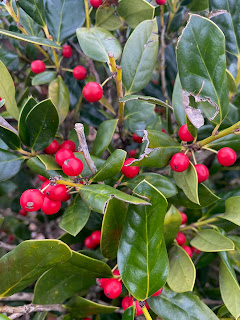
Holly is some 600 species of evergreen trees and shrubs that like to grow in tropical and warm areas worldwide. The plants like sun to part sun and well-drained soil. Some varieties can live to 100 years old. 

Historically, Holly has been gathered as a Christmas decoration and has been associated with the crown of thorns on Christ's head due to the spiky leaves. 

Holly plants are best known for their bright red berries that remain on the plants for up to 6 months and are an important source of food for birds in winter. Small mammals also eat the berries and leaves. Different varieties of holly produce berries in pink, blue, orange and white. Holly berries are poisonous to people and pets. 

Most Holly plants are dioecious, meaning they produce either male or female flowers. Female plants rely on nearby male plants to be pollinated, otherwise they will not produce berries. Only female plants produce berries. Male plants need to be within 50 feet of a female holly plant.

Holly is symbolic of balance - it takes a male and female plant for berries to be produced. The concept of male and female, each put on the end of a balanced scale, with provide balance with the concepts of the masculine and feminine in life. The plants have spiky leaves, which keep animals away, and they have berries that nourish birds and small animals. Again, we have concepts that when put on either side of a scale, plant protection and small mammal and bird nourishment, balance out. Holly can remind us to look at each side of an issue and to look at the balance that can be often found in the whole. And also the idea that some people can be prickly on the outside but, in balance, can be compassionate on the inside. 

Most Hollies keep their leaves through the winter which offer protection for nesting birds. As food sources become scarce in winter, Holly is a steady food source for birds and small mammals.  

The energetic concepts of balance and protection lend themselves to providing a solid foundation for meditation for our daily lives. Holly can be used as the base or as a starting point for a journey or meditation if you're interested in bringing a strong concept from nature into your spiritual practice. If you feel an affinity to Holly or are in a place where you feel the need for protection or of feeling safe, you can call on the spiritual energy of holly to surround you with its spiky leaves and protective energy, not allowing in anything that doesn't serve your highest good. While nestled in the protection of the branches, you can use the image of the nesting bird to spread your wings (your imagination) to reach into the higher realms. 

Planting Holly near your home can bring the properties of balance and protection to your living space. 

Holly can be propagated through seeds and cuttings.

  • English Holly (Ilex aquifolium) is native to Europe, North Africa and Western Asia. Plants grow 15 to 50 feet tall and up to 15 feet wide and have dark green spiny leaves. Small white flowers produce  red, yellow or orange berries.
  • American Holly (Ilex opaca) is native to Eastern and South Central United States. Plants grow 25 to 50 feet tall, with some up to 70 feet. Plants have dark green spiny leaves that have been used to make tea to treat colds. 
  • Winterberry (Ilex verticillata) is native to eastern North America. Plants grow up to 12 feet and  produce clusters of bright red berries. Also known as Michigan Holly and Black Alder. 
  • Chinese Holly (Ilex cornuta) is native to China and Korea and grows from 15-25 feet tall and 20 feet wide. It has dark green leaves and produces red berries. Plants will grow in hot and humid conditions and are drought tolerant. Also known as Horned Holly. 
  • Japanese Holly (Ilex crenata) grows up to 10 feet tall and is native to Eastern Asia. Plants grow less than 6 inches per year. 

Holly is used as a Bach Flower Remedy to stimulate a loving nature towards others.  Holly is also available as an essential oil.


Jasmine

Jasminum Cancer, Capricorn  Clairsalience, Moon Energy Jasmine grows as a flowering shrub and vine warmer areas of Europe, Asia and Africa. ...