Showing posts with label flower symbolism. Show all posts

Sunday, August 3, 2025

Jasmine

Jasminum

Cancer, Capricorn 

Clairsalience, Moon Energy

Jasmine grows as a flowering shrub and vine warmer areas of Europe, Asia and Africa. Plants are known for their small, starry white or pale yellow flowers that bloom in clusters. Flowers have an intense, sweet fragrance that intensifies in the evening. Flowers are used for fragrances, teas (made by infusing tea leaves with jasmine flowers), and to make essential oil.

Jasmine plants prefer full sun but will grow in part shade. They thrive in moist, well-drained soil. Many varieties are evergreen; leaves stay green all year.  Although white and yellow flowers are common, some varieties produce pink flowers. Not all varieties are fragrant. Jasmine shrubs typically grow about 2 feet (60 cm) tall and 5 feet (1.5 meters) wide. Vining varieties can reach up to 10 feet (3 meters) in height but require support to grow upright. Wherever the vine stem touches the ground, it can root and spread. 

Jasmine blooms at night and releases its strongest fragrance under the moonlight. In India, Jasmine is also called the Queen of the Night because of the strong night time scent. People drawn to jasmine energy tend to feel at ease in nighttime stillness and may find that their spiritual gifts—especially those related to healing, intuition, or dreamwork—are strongest under the moon. Experiment with cleansing crystals or other objects with moonlight--for you this may prove to be more effective than working at other times. People attracted to Jasmine may also be comfortable working with darkness. It supports shadow work, releasing fear-based energies and bringing hidden truths into light.

Jasmine vines can root where they touch the ground. This shows us Jasmine is representative of people who have been doing this work for many lifetimes and are here to perfect their skills or awaken others.

Archangel Haniel may be called on when working with moonlight energies.  

Pay attention to the sense of smell. Working with Jasmine may enhance clairsalience ability--the ability to receive spiritual messages through scent. You may smell jasmine, roses, or even scents like fresh bread or smoke as signs from spirit. This sense is every bit as important as other psychic abilities as all of them provide information from spirit for us to use for ourselves or for others. These sensory messages can offer comfort, memory or confirmation.   

Essential oil extracted from jasmine flowers are used to relieve stress, anxiety and insomnia. Some traditional medicinal practices use jasmine for its potential antiseptic and anti-inflammatory properties. Some varieties contain compounds in leaves, flowers, sap or berries that are toxic to animals and people. However, Jasmine essential oil can be diffused near pets. In the garden, Jasmine attracts hummingbirds and butterflies and is deer resistant.  

The name Jasmine comes from the Persian name Yasmine which means "Gift from God." In Hinduism, Jasmine is offered to deities as a sign of devotion. The white blossoms are seen as pure, sacred and spiritually uplifting.

Popular types of Jasmine: 

  • Common Jasmine (Jasminum officinale) is known for its highly fragrant white flowers. It's also known as Summer Jasmine, Poet's Jasmine, or White Jasmine.
  • Arabian Jasmine (Jasminum sambac) has intensely fragrant, white flowers, especially in the evening.  
  • Royal Jasmine (Jasminum rex) is a fast growing vine hardy that produces white flowers almost all year. 
  • Winter Jasmine (Jasminum nudiflorum) is known for its bright yellow flowers that bloom in winter and ability to tolerate colder temperatures.
  • Pink Jasmine (Jasminum polyanthum) produces clusters of fragrant pink buds that open to white flowers 


Tuesday, July 29, 2025

Yucca

Yucca filamentosa

Aquarius 

Endurance, Spiritual Relationships

Yucca plants are a diverse group of perennial shrubs and trees native to the arid regions of North and South America. Recognized by their sword-shaped leaves and tall flowering spikes, yuccas thrive in dry, sandy, or rocky soils. While often associated with desert environments, many species have also adapted to coastal conditions. Plants store water in their trunks or bases, allowing them to survive extended droughts. 

Yuccas prefer consistent full sun and well-drained soil. They grow slowly and are exceptionally long-lived—some living up to 100 years. Their white  flowers, 1 to 2 inches across, bloom once a year in summer or early fall and grow in clustered spikes that can reach up to 30 feet tall.

The leaves of yucca range in color from green to silvery-blue and may be edged or streaked with variegation. Leaves are typically long (up to 3 feet) and narrow with pointed tips, growing in a rosette pattern radiating from a central point. Some species, like Yucca filamentosa, produce fibrous leaves that Indigenous communities have long used to craft ropes, baskets, and mats. Yucca roots and flowers have also been used in Southwestern cooking, and yucca root extracts have featured in traditional medicine, especially for inflammatory conditions like arthritis. 

Yucca flowers emit a fragrance at night that attracts Yucca Moths. The moths work with the Yucca plant in a unique mutualistic relationship: the moths lay their eggs inside the yucca flowers, and in return, the plant is pollinated by the moth. The caterpillars feed only on yucca seeds. 

The relationship between Yucca flowers and Yucca Moths is symbolic of our relationship to spiritual realms, to our deceased ancestors, angelic beings, guides and others. The Yucca flower emits a fragrance that attracts moths - similar to the way we call to our spirit helpers to assist us in this lifetime. The Yucca Moth reciprocates and pollinates the plant, symbolic of spirit helpers providing us with the guidance and assistance we request or need. These roles can also be reversed; our spirit helpers are always calling us in the direction that best serves us. 

Yucca is an example for people who have come into this world with an understanding of our relationships with spirit, for those who are already on their spiritual paths and ready take those next steps according to how they are called or guided.  

Yucca plants show us a variety of characteristics that personify endurance. Plants can live in desert-like condition yet are drought tolerant. People drawn to yucca plants are those who have landed in conditions that are less than ideal and who thrive. Despite living in difficult conditions, plants are very long-lived. People who chose work with yucca energy can expect to outlast their difficult conditions and live to mature ages. 

The elements of endurance and spiritual relationships that yucca brings are also very grounded, as yucca plants also have very practical uses.Traditionally, plant leaves are used to weave rope and baskets, sturdy staples used to enhance day to day living. Those working with yucca energy can expect to be those who have very "practical" approaches to their spiritual lives.

Yucca flowers are toxic to horses, dogs and cats.

Yucca have been called Adam's Needle or Spanish Bayonet or Spanish Dagger due to the sharp leaves. The Yucca flower is the state flower of New Mexico. 


Tuesday, June 24, 2025

Alyssum

 Lobularia maritima

Virgo

Alyssum

Sense of Order, Resilience

Alyssum, also known as Sweet Alyssum, is a low-growing, fragrant flowering plant native to Europe. It forms soft mounds 3–9 inches (7–23 cm) tall and can spread 12–24 inches (30–60 cm) wide. The plant produces tiny, clustered flowers—most often white, though pink, purple and cream varieties are also available. Each tiny flower has four petals; flowers have a sweet scent. Plants bloom from spring through fall, especially in cooler weather. 

The leaves are small, narrow, and gray-green. Alyssum is perennial in warm climates but is typically grown as an annual in colder regions. It thrives in full sun but also tolerates partial shade and prefers well-drained soil. Known for its resilience, Alyssum tolerates poor soils, light frost, salty air, and even sandy beaches, making it especially suitable for coastal gardens. High heat and humidity in mid-summer may temporarily stop plants from blooming. 

Alyssum symbolizes resilience - the ability to thrive in harsh or shifting conditions without losing perspective or balance. The plants stop blooming when conditions become too extreme. Just as the plants conserve energy during peak heat, we can withdraw until conditions, although possibly still harsh, are once again supportive. Alyssum reminds us that while we may endure chaos, we can also discern which environments are simply too “hot” for growth. 

Shallow-rooted, fast-growing and easy to cultivate from seed, Alyssum often self-sows in garden beds. It attracts pollinators such as bees and butterflies and makes an excellent companion plant in vegetable gardens. As a ground cover, it creates tidy borders and fills open spaces evenly, lending a sense of order to garden designs.

People drawn to Alyssum tend to bloom steadily through adversity, offering order and direction in times of disorder. Others may be naturally attracted to them—just as pollinators are to Alyssum—because of the stability and order they bring. Picture the person calmly directing traffic at a chaotic event, guiding cars into neat rows, or the greeter helping people find their way through a busy venue. Yet Alyssum also reminds us: if conditions become too overwhelming—like a crowd turning unruly—we can easily self-sow to begin again somewhere else. 

Physical plant characteristics also are guidelines to the spirit of Alyssum. Flowers have four petals: the number four symbolizes stability, security and direction, supporting Alyssum's themes of order and resilience. Flowers are primarily white which is associated with Archangel Gabriel, who symbolizes purity and has the role of messenger. Meditating or reflecting on the number four and/or asking for assistance from Archangel Gabriel may be helpful when exploring current challenges, especially when determining when your environment becomes too "hot" and next steps are needed.   

The plant contains compounds with antioxidant, anti-inflammatory and antimicrobial properties. It has been used in folk remedies as an anti-inflammatory and diuretic, often given as a tea. In ancient Greek medicine, the name “Alyssum” (“a-lyssum”) meant “without madness,” and the plant was believed to calm emotional imbalances, especially anger.  In folk medicine, Alyssum was used to treat animal bites.

Wednesday, June 4, 2025

Jewelweed

Impatiens capensis

Libra 

Resiliency, Walking in Shadows

Jewelweed, also called Spotted Touch-Me-Not, is a native North American annual that thrives in moist, shaded spots like wetlands, forest edges and stream banks. Easily recognized by its striking orange or yellow trumpet-shaped flowers—often dotted with red or orange spots—this plant gets its name from the way its blossoms dangle on slender stalks, each featuring a curved spur that gives a jewel-like sparkle.

Growing 2 to 5 feet tall, Jewelweed blooms from late spring through early fall. Its light green, oval leaves have finely toothed edges and are arranged alternately along smooth stems. One of the plant’s most notable traits is its natural water repellency: rain and dew bead on the leaves, reflecting light and creating a silvery shimmer. This luminous quality speaks to spiritual clarity and the ability to reflect light even when surrounded by shadows—an apt symbol for those who walk among darkness without absorbing it. 

Jewelweed attracts bees, butterflies, and hummingbirds, relying on cross-pollination from these visitors. It also produces cleistogamous (self-fertilizing) flowers that never open, ensuring reproduction even in the absence of pollinators. This trait symbolizes quiet resilience—the inner strength to endure, adapt and continue. It mirrors the strength needed by those who navigate shadow realms, whether physical or spiritual. Jewelweed also exhibits resiliency in its growing environment; plants grow at marsh edges and creek sides and also in ditches and road cuts. 

The plant’s natural water-repelling leaves shimmer with rain, symbolizing clarity and the ability to reflect light even in shadowed places. This quality reminds us to maintain our own clarity and boundaries, repelling negativity and holding space for healing. People attracted to Jewelweed are those who can walk into shadows bringing light with them. Despite blooming on delicate stalks, the plant models the resilience required to work in shadow worlds: difficult, heavy or emotionally charged environments. Its presence can be symbolic of professions that enter the dark to bring light: police officers, firefighters, paramedics, therapists, and spiritual healers. These individuals may excel at leaving behind the burdens of what they witness, maintaining personal clarity and light in the face of darkness. 

Its nickname “Touch-Me-Not” comes from the ripe seed pods that burst explosively when disturbed. This can be taken as a reminder for people close to those in helping professions that they too have limits, and can be explosive when pushed to extremes.  

Jewelweed’s sap has been used as a folk remedy to soothe the itching, redness, and inflammation caused by poison ivy’s urushiol oil. Applying the juice from jewelweed’s stems and leaves can help neutralize the rash, reduce discomfort, and speed healing, making it a natural first aid companion wherever poison ivy grows. This relationship symbolizes balance and harmony between challenge (shadow worlds) and healing. Plants have also been used in folk medicine for anti-fungal properties.

Jewelweed is also known as Orange Jewelweed, Common Jewelweed, Spotted Jewelweed and Orange Balsam.


Sunday, May 11, 2025

Cosmos

Cosmos 

Libra
 
Universal order and beauty

Named after the Greek word "kosmos," meaning order and beauty, Cosmos is a vibrant flowering plant that produces
Daisy-like flowers with a central disk and radiating petals. Flowers are on upright stems and grow from two to four inches across Cosmos are colorful and can be found in white, pink, red, purple, orange and yellow. Plants like full sun and well-drained soil and can grow in poor to average soil. Flowers bloom profusely from summer to fall. People who are attracted to Cosmos flowers can look on the symbolism of continuous blooming and apply it to life - these are the people who continue to grow and thrive. These are the people that demonstrate continuous color and joy in their lives and extend that joy to others. These are the people you want as friends.

The Greeks named this plant after its primary attributes, order and beauty. Those with Cosmos energy see the natural order and beauty both on the earth and on a universal scale. These are the people who have an innate knowing that all is well at home and on a grand universal scale. These are the people who see through the chaos, disorder or ugliness of a situation to the natural order that guides all systems. For example a decaying garbage dump smalls and looks unsightly but will become compost; the house that was torn down will make room for new land use. They trust that even with violent cosmic events, the point of destruction will become the point of creation. They understand that as above, so below, and therefore all is well with humanity.

Cosmos attract bees, butterflies, hummingbirds and hoverflies, which help pollinate nearby plants. Cosmos supports the cycle of life by facilitating pollination and continues the propagation of beauty of nearby flowering plants.

Cosmos grow from one to six feet (60–180 cm) tall; their height can provide light shade for shorter, sun-sensitive plants. Plants have feathery, fern-like leaves that are a medium to bright green. Plants grow from  1 to 3 feet (30 to 90 cm) wide.

Plants are typically grown as an annual but some species are perennial in warm climates. Plants are most commonly germinated from seed, which takes from 7 to 21 days. In keeping with the theme that points of destruction lead to creation, cosmos self-seed fairly easily.

Cosmos are heat-tolerant and grow best in warm temperatures.  Plants are deer-resistant and are native to Mexico and Central America. These plants belong to the Asteraceae family, which includes daisies, sunflowers and asters. 


Wednesday, May 7, 2025

Lily

Stargazer Lily

Lilium

Taurus

Balance, Stability, Unfolding

Lily is a perennial plant known for its large flowers and fragrant aroma. The trumpet-shaped flowers grow wide range of colors including white, pink, orange, red, yellow and purple, some with contrasting spots or stripe. Flowers have six petals which are often curved backward or flared out. The angel number six which is symbolic for balance. Flowers can be upright, downward-facing or trumpet-shaped, depending on variety. They can be 4 to 10 inches across.

The leaves are usually long, narrow and lance-shaped, growing in an alternate pattern along the stem. Lily stems can range from 2 to 6 feet tall (60 cm to 1.8 meters).

Lilies grow from bulbs. Lilies like full sun to partial shade and well-drained soil. Most lilies are perennial and will multiply over time. Plants can be divided every 3 or 4 years.

The number of petals, six, is predominant in the symbolism of this flower. Six is an even number and the first perfect number -- the sum of its proper divisors equals itself: 1 + 2 + 3 = 6. It is also the number of faces on a cube. Mathematically and from an angel number perspective, six represents balance and stability. People who are drawn to lilies can look at balance in their lives, work and home, material and spiritual needs, and responsibility for self and service to others. Lily also brings the energy of stability; people working with the energy of lily will find it easier to balance these areas of their lives and will be able to easily bring their lives back into balance if they focus on one area for too long. 

Lily also brings the energy of unfolding: a life path unfolding in front of you, education on topics of interest unfolding in a balanced manner, the truth of a subject or area unfolding. People working with lily understand this process; often things are revealed as a series of steps unfolding before you. Lily shows us that this is a natural process. People working with Lily know that all sides of a cube are not visible at the same time; they have the innate knowing that everything unfolds and is known in perfect timing.

Lilies are toxic to cats and mildly toxic to dogs and some livestock.

Lilies are native to temperate regions of the Northern Hemisphere, including Asia, Europe and North America.  

Daylilies are not considered Lilies as they do not grow from bulbs.

Below are some well-known types:

  • Asiatic Lilies (Lilium asiatica): Flowers are upward-facing and have no scent; earliest bloomers.
  • Oriental Lilies (Lilium orientalis): Large, fragrant flowers in bold colors; bloom later in the summer and often hang down. Native to Japan.
  • Trumpet Lilies (Lilium longiflorum hybrid): Large, trumpet-shaped flowers, often with a strong fragrance. Native to Asia.
  • Martagon Lilies (Lilium martagon): Nodding blooms (downward facing) with recurved petals. Plants are woodland-friendly. Native to Europe and Asia.
  • Tiger Lilies (Lilium lancifolium): Orange flowers with dark spots bloom from mid- to late summer. Originated in East Asia.
  • Easter Lilies (Lilium longiflorum): Produces white flowers in summer. Native to Japan.
  • Madonna Lilies (Lilium candidum): Flowers are white and bloom early in the summer.
  • Stargazer Lilies (Lilium orientalis 'Stargazer’): Produces pink and white flowers with a strong aroma. 
  • Crinum Lily
    Crinum Lilies (Crinum): Native to tropical and subtropical regions worldwide, including Africa, Asia and the Americas. Plants have strap-like leaves that can grow up to 3 feet (90 cm) in length.
  • Monday, May 5, 2025

    Clover

    Trifolium repens

    Aries 

    Natural cycles

    Sustainability

    Clover is a small perennial plant that has three leaves and is often found in meadows, lawns and pastures. It is a common name for plants in the genus Trifolium, which means "three-leaved". Some clovers have the rare four leaf structure, which are considered to be a symbol of good luck. Plant leaves are oval shaped and are typically green with a faint, lighter green or white "V" or crescent pattern near the base. Clover contributes to sustainability of nearby plants: flowers are a rich source of nectar and pollen, which attracts bees, butterflies and other pollinators. The presence of clover increases pollination rates for surrounding crops.

    Clovers are generally low-growing plants. White clover, for example, tends to spread along the ground, creating a dense mat. Red clover is more upright and can reach heights of up to 20-30 inches (50-75 cm). Clover likes moist, cool climates with well-drained soil.

    Clover plays a beneficial role in sustainable agriculture, soil health and biodiversity. Clovers are known for their ability to fix nitrogen in the soil, which enhances soil fertility.  Clovers convert atmospheric nitrogen into a form that plants can use, enriching the soil. Clover's dense root system helps stabilize soil and reduces erosion. Clover is a high-protein, palatable forage for livestock. It can be grazed or harvested for hay. 

    Clover represents sustainability for the earth, for animals, and ultimately for people. Clover is a benefit for the earth: it enhances soil nitrogen, reducing the need for synthetic fertilizers. Future crops planted in the same soil benefit from the enriched nitrogen, providing food for animals and people. Clover is often used to restore nutrients in soil that housed nutrient-draining crops. Clover also suppresses weeds naturally. 

    Clover is easy to grow - it will germinate from seed thrown on the ground. 

    Clover provides a nutrient-rich food source for domesticated and wild animals. It assists in the food chain: cattle, sheep, goats and horses graze on clover in pastures or eat it in hay. Rabbits, deer, groundhogs and wild turkeys also eat clover. 

    Clover fits into the cycles of support for animals and our growing cycles. People with a passion for clover may find they also easily fit into working in areas of nature of with part of natural cycles.

    Well known species of Clover:

    • White Clover (Trifolium repens): A low-growing perennial plant with white or pinkish flowers, commonly found in lawns and pastures. It's often used as a ground cover due to its ability to spread quickly.
    • Red Clover (Trifolium pratense): Taller than white clover, this species has red or purple flowers and is often grown as a fodder crop for livestock or as a cover crop to improve soil health.
    • Lesser Trefol (Trifolium dubium): Native to Europe and is often considered the plant representing the Irish Shamrock. Produces tiny yellow flowers.
    • Crimson Clover (Trifolium incarnatum): Known for its vibrant crimson flowers, this clover is frequently used as a cover crop to prevent soil erosion and improve soil quality.

     Four leaf clovers are a genetic anomaly. Chances of finding one are one in 5,000 to 10,000. 


    Friday, May 2, 2025

    Clematis

    Clematis spp.

    Gemini 

    Personal growth
    Personal support and beliefs 

    Perennial vine (deciduous or evergreen depending on variety), that produces large, often showy blooms in white, purple, blue, pink, red or bi-color. Plants like full sun on top, with cool/shaded roots. Vines will climb trellises, arbors, fences or trees by twining leaf stems.

    Clematis flowers are star-like, with 4 to 8 petals (sepals) that may be flat, ruffled or recurved.  Bloom times depend on variety, from spring bloomers to fall bloomers. Leaves are deciduous or evergreen and are a medium green. As the vine grows, it sends out long stems with leaves spaced along them. Each leaf is attached to the stem by a slender stalk (the petiole) and when the petiole touches a support (such as a trellis), it coils around it anchoring the vine in place. Without a support, vines will sprawl on the ground. Plants are deer- and rabbit-resistant.

    Clematis teaches us about personal growth. It reaches ever higher and blooms brightly - with support. What are you reaching for? Regarding personal growth, do you need continuing education, experience or mentorship to reach your goals? All of these support our continued growth for a lifetime. Have you chosen the mentor, the educational institution and your support network wisely and for the right reasons? Do all of them have the integrity that you have?

    The other side of being supported is an examination of what you may be clinging to. Are you relying on continued mentorship or learning when you've become the person with experience who should now be the teacher?  Do you have old beliefs that are not your own or old boundaries that served you in your youth, such as keeping people at arm's length, that are no longer needed? 

    Are you ready to let go of your support and "sprawl on the ground" for a while as you grow you own support in life? Keep in mind that without support, Clematis continues to bloom. 

    Clematis blooms in a variety of colors and in a variety of seasons. You can chose your own color or season in which to bloom, as well as the color of your beliefs. You can chose to bloom in all colors and all seasons. Be prepared for your beliefs to change as you grow ever higher on your own trellis and reach for the stars.

    Many popular ornamental species originated in China and Japan; plants have been used for thousands of years in traditional Chinese medicine. Clematis is used in folk medicine for topical and other ailments and is also used as a Bach flower remedy to help with focus.

    Some varieties are:

    • Clematis 'Jackmanii' – deep purple, summer bloomer
    • Clematis montana – spring bloomer, fragrant
    • Clematis 'Nelly Moser' – light pink with deep stripes
    • Clematis 'Sweet Autumn' (terniflora) – late bloomer with white flowers and a strong scent
    • Clematis vitalba-- found across central and southern Europe. Also called Traveler's Joy or Old Man's Beard


    Saturday, November 2, 2024

    Edelweiss

    Leontopodium nivale

    Strength, Reflection

    Edelweiss produces star-shaped, white flowers. Plants grow at high altitudes, reflecting the stars back to the cosmos and representing the stars on Earth. Edelweiss is for people who feel a strong affinity to the cosmos or if you look at the night sky and you feel you are part of or connected to universal energy. Edelweiss flowers represents the earthly symbolism of the cosmos, an energy that may help with defining your truth, your core beliefs, within your musings and meditations. 

    The plants are well-adapted to harsh environments, showing the strength of the people of the Earth and our ability to survive in difficult conditions. Edelweiss has woolly, white flowers and leaves covered in dense, tiny hairs that protect it from cold, drought and intense sunlight. Plants grow low to the ground, from 3 to 8 inches in height. It forms a compact, mat-like cluster of stems and leaves, allowing it to thrive in rocky, high-altitude environments. This plant shows us how to gather ourselves into the core of our being to survive difficult external conditions as well as the glare of the opinions of others. People who work in public jobs can reflect on this energy to gather themselves into the strength of their own truth, to move forward, while those them may offer opinion and speculation on what they think that truth means. 

    These small, perennial alpine plants are native to the mountainous regions of Europe, particularly the Alps and the Carpathians. Edelweiss grows in rocky, limestone areas at high altitudes, often above 5,900 feet (1,800 meters). Flowers bloom from July to September. 

    What appears to be a single Edelweiss flower is actually a cluster of small, yellowish florets surrounded by several leaf-like bracts. The plant's leaves are narrow, lance-shaped, and also covered in a silvery, woolly texture. This adaptation helps the plant retain moisture. Edelweiss tolerates strong winds, low temperatures and poor soil. It shows us that we too can bloom no matter where are we are planted and can thrive in difficult or harsh living conditions.

    Edelweiss can be propagated from seed.  Seeds respond best when kept cold for a period of weeks before planting and take from 2 to 6 weeks to germinate.

    While once picked almost to extinction, Edelweiss is now a protected species in many areas. In traditional herbal medicine, Edelweiss has been used for its anti-inflammatory, antioxidant and antimicrobial properties. The flower is also used in cosmetics. 

    Edelweiss is the national flower of Austria, Bulgaria, Italy, Slovenia and Switzerland. 


    Monday, September 9, 2024

    Mullein

    Verbascum thapsus

    Aquarius, Gemini, Leo, Taurus

    Journey from darkness to light

    Mullein is a tall, biennial herbaceous (non-woody) plant known for its tall, yellow flower spikes, medicinal uses and resilience in a variety of environments. Mullein has a taproot that helps it access deep water sources, allowing it to thrive in dry or rocky soils.

    Mullein leaves are oval to lance-shaped, and can grow up to 12 inches (30 cm) long. Leaves are larger at the base of the spike. The leaves grow in a circular pattern close to the ground during the plant’s first year. The leaves are covered in dense, soft hairs, giving them a velvety feel and are typically a gray-green or silvery color due to the fine hairs. Exposure to cold is required for the plant to flower the following year. 

    The second year, plants produce a flower stalk that is 6-10 feet (1.8-3.04 meters) tall. Each stalk is covered in numerous small, five-petaled flowers.  The flowers are typically bright yellow, though some species may have white, pink, or purple flowers. Flowers bloom a few at a time in late spring or through summer. Historically, mullein stalks were dipped in tallow or wax and used as torches due to their long, straight form and slow-burning qualities. 

    Plants produce tiny seeds that require light to germinate. Seeds can live for a very long time in the earth then germinate when the earth is disturbed and the seeds are exposed to light.

    Mullein has been used in traditional medicine for centuries, particularly for respiratory issues. It has also been used as an anti-inflammatory and for topical pain relief. Flowers and leaves have been used to produce yellow or green dyes.

    Mullein is native to Europe, North Africa, and Asia, though it has spread to many other parts of the world.

    Mullein is symbolic of our journeys of moving through darkness to reach light. Mullein's taproot enables the plant to live in dry and rocky soils.  Sometimes we too need to live in areas that are challenging, and the plant's taproot symbolizes that we can be grounded even as we move through those challenges. The taproot keeps us deeply rooted in our humanity as we move away from the undesirable toward that which brightens our souls. 

    The journey through darkness can be where one travels to a more open level of spirituality, towards a more comfortable level of health, towards greater financial stability or towards other aspects that make life more fulfilling or comfortable. If this is your path, you can use the image of Mullein being used as a torch that lights your way, that illuminates the path before you and helps you to see it clearly. If you are drawn to Mullein, know that even if you are in a difficult situation that needs improvement, the path before you is well lit. Your job is to take the needed steps along that path.   

    Mullein types include: 

  • Great Mullein (Verbascum thapsus): This is the most well-known species, often found in North America, is identified by its tall flowering spike and densely hairy leaves. Also known as Common Mullein, Flannel Plant or Wooly Mullein.
  • Moth Mullein (Verbascum blattaria): A shorter species with white or yellow flowers, commonly found in disturbed areas.
  • Purple Mullein (Verbascum phoeniceum): Known for its attractive purple flowers, this species is often grown in gardens.
  •  

    Saturday, June 29, 2024

    Lantana

    Lantana


    Abundance, Knowing (Cognisance)

    In tropical and subtropical climates, Lantana is a fast growing perennial. In cooler climates, it is grown as an annual. The plants like sun to part shade and, once established, are heat, salt and drought tolerant.  The plants like well drained soil. 

    Lantana grows clusters of small, tubular flowers that are from from 1 to 2 inches across, that may be of different colors, including white, yellow, orange, pink, red, purple or blue. Flowers start with one color hue then gradually transition through a spectrum of colors as they mature. Flowers grown as annuals bloom from April to October. Plants in tropical climates bloom year round. Lantana flowers attract bees, hummingbirds and butterflies. Leaves are deep green and are poisonous to most animals.

    Lantana can be propagated from seeds or stem cuttings.  The plants are native to tropical and subtropical areas of North, Central and South America and have have also grown in Africa for hundreds of years. 

    Lantana has been used as an herbal medicine for its antimicrobial, fungicidal and insecticidal properties.

    Abundance - profusion of flowers throughout the growing season. Lantana is good for people who may have been practicing the concept of lack - that they are not deserving or worthy of all the richness in life or can't afford the lovely things life has to offer. If the richness of life is not flowing to you, meditate on how your beliefs: are you not deserving or worthy? Do you think that being spiritual or creative also means you need to live in poverty? Check to see if your belief system is holding you back from abundance in life. 

    Lantana keeps blooming all summer so if you falter in thinking you are not deserving of abundance, the profusion of flowers provides a fresh reminder that abundance is available to you and to everyone at all times. The need to deadhead or prune the flowers to encourage new growth is a reminder to pay attention - keep your focus on abundance, on feeling as if the abundance of life is available to you, and it will continue to flow for and to you. 

    Lantana produces nectar in their flowers which attract butterflies and hummingbirds. The butterflies and hummingbirds land and consume nectar, then fly away. Imagine each contact establishing a small thread from flower to another destination, from earth to spirit, from our present consciousness awareness to another dimension. People who experience spiritual knowing have these similar threads from their consciousness to spirit - many, many delicate connections that manifest as a deep trust or knowing. These are the people who came into this life not seeking a connection with light but with their lights already on. If you are one of these people, you'll have deep spiritual awareness as part of your being. While others may have powerful awakening experiences, you will already have a solid base of knowledge of what it means to be spiritual and connected to spiritual realms. So don't be surprised if you experience a small wave of change when others experience a tsunami. 


    Saturday, November 18, 2023

    Oleander

    Nerium oleander

    Aries

    Boundaries, Illusion

    Oleander are flowering shrubs that grow in warm and subtropical areas. The 5-petal flowers bloom in spring and continue into the fall, growing in clusters of white, yellow, purple, pink or red. In contrast, the pointed leaves are long (up to 7 inches) and narrow (less than 1 inch) and are a deep green. The plants grow from 6 to 12 feet tall and are about the same width. They can grow from 1 to 2 feet a year. Oleander typically grow in mounds but can be trained to grow as trees.

    Oleanders like full sun and well-drained soil but will adapt to other soil conditions. Once established, plants tolerate heat, drought, salt spray and wind. Cuttings from Oleander can be grown in water before planting or grown in soil. Oleander can also be grown from seed.

    Plants are native to North Africa and the eastern Mediterranean areas. Oleander was introduced to Florida in the 1500s and grows in North American temperate areas. It can be damaged by the cold.

    All parts of the plants are toxic to animals and people. Sap from Oleander causes skin irritation. If plants are burned, the smoke is also toxic. 

    Oleander flowers have 5 petals. The angelic meaning of the number 5 is that positive life changes are present, and to be optimistic about current conditions to create positive future conditions. 

    Oleander's poisonous qualities show you how to set boundaries. You can meditate using the image of Oleander flowers or call on the energy of Oleander if you have the need to set limits on your time, space or resources. It also helps to teach how to set limits on our emotions and how to effectively detangle emotions of others from our happiness.

    Oleander shows us the power of illusion. On the surface, Oleander is an ornamental plant that is very tolerant of growing conditions in warm regions. The idea that Oleander is only an ornamental plant is an illusion, as it really is a poisonous plant. It shows us that people can present themselves as "ornamental" when they are really much more complicated. Oleander teaches us to look beyond the face value of a person and beyond what they say (the illusion) to the qualities the person embodies, to their true nature. Conversely, Oleander teaches us about the illusion that life is the whole of our reality, when the universal reality is that we are powerful souls who have a long history and a long, evolving future.  

    Oleander has been used for heart conditions, asthma, cancer, and other conditions. It contains chemicals that can slow the heart rate. 

    Common names for Oleander include Kaner, Rosebay and Rose Laurel.


    Monday, November 13, 2023

    Evening Primrose

    Oenothera biennis

    Connection to Spirit, Working with Spiritual Realms

    The Evening Primrose originated in North America and grows throughout South America, Europe and some parts of Asia. The plant produces four-petaled flowers that are fragrant. The plant is best known to produce yellow flowers that are 2 inches across. Some plants produce flowers in pink, red, purple and white. Flowers are closed during the day and open at sunset, attracting moths and bats. Before flowers close in the morning, they attract bees, butterflies and birds.

    Plants grow from 3 to 5 feet tall and about 2 feet wide. Because they self seed, plants tend to sprawl. Plants grow well in full sun or partial shade and like well drained soil. They are drought tolerant and deer resistant.

    Evening Primrose seeds are used to make Evening Primrose oil, which is used for skin conditions, premenstrual syndrome (PMS) and menopause symptoms. Native Americans used the plant as a topical skin conditions such as bruises and inflammations. Leaves were ingested for sore throats. 

    Flowers are used to make a flower essence that is suggested for use to treat emotions from early childhood. 

    Evening Primrose flowers have four petals. The number four is associated with many divine properties: the four elements (air, earth, water and fire) and with the four directions (east, south, west, north). The elements and directions have application in shamanism, the path of direct revelation in the spirit world and way to connect with all of creation. In numerology, the number four is associated with the energy of the Archangels, who work with people continuously through messages, healing and in all things when asked.

    Evening Primrose symbolizes working with spiritual realms for healing, providing loving messages from loved ones who have passed (mediumship), providing messages from guides, angels or brothers and sisters of the light (ascended masters) and light councils for messaging (channeling) or healing (Reiki and other hands-on modalities).

    Those who identify with the qualities of Evening Primrose are also able to see things in the dark, meaning those places where lower energies reside. Those who work in spiritual realms can call that which is in darkness into the light, to send lower energies to the light or to remove lower energies so that people may live more fully.  

    Evening Primrose are primarily or most commonly yellow.  Yellow symbolizes joy, and those who connect to spirit and who work with the spiritual realms experience the joy that spirit brings to all of us. 

    The Evening Primrose Flower has also been called Common Evening Primrose, Evening Star, Sun Drop, Fever Plant, Hog Weed, King’s Cure-all or Cure All.  


    Friday, June 23, 2023

    Forget-Me-Not

    Myosotis sylvatica 

    Taurus

    Angel energy, Angel symbolism

    Forget-Me-Not is a flowering perennial plant that typically grows up to 5 inches in height with some varieties growing up to 1 foot tall. Plants bloom in spring or summer with clusters of small (3/8 inch across) blue flowers with five petals that have yellow centers. Some varieties of Forget-Me-Nots have white, yellow or pink flowers. The small flowers attract bees, butterflies and moths. 

    Forget-Me-Not can be grown easily from seed and reseeds on its own. After one year, plants reach maturity and flower. Plants are easy to maintain; they like sun and part shade and tolerate heat and cold as well as wet soil. Plants are rabbit and deer tolerant. 

    Plants are native to Europe and now grow in temperate areas all over the world. The Latin name Myosotis is from the Greek words mus and ous, meaning mouse ear. The plants have short pointed leaves that are similar to mouse ears. 

    Forget-Me-Nots grow on riverbanks and in damp ditches, in meadows, in the woods, in rocky places in the mountains. Alpine Forget-Me-Not (Myosotis alpestris) - the official flower of Alaska, and Mountain Forget-Me-Not (Myosotis asiatica) grow at higher elevations in moist mountainous areas.

    Forget-Me-Nots present us with a combination of very common and very unique characteristics.  Common attributes include being easily grown from seeds and easily reseeding itself. Also, plants are not particular about their growing conditions.

    The flowers are fragrant in the evening and night, and are not fragrant during the day. Another unique characteristics is that the plants have true blue flowers. Less than 20 percent of plants have blue flowers. Blue is symbolic of the color of Archangel Michael, who brings us his energy, support and protection.

    Flowers have five petals that surround a yellow center. The angelic meaning of the number 5 is that angels are bringing you messages, often of life changes. You can reflect on Forget-Me-Not flowers when you are in times of personal and professional change to encourage inspiration on the direction of your choices.

    Forget-Me-Nots regenerate themselves, creating a continuous cycle of birth. Angel energy also is forever continuous and regenerates endlessly, being activated from the angelic realm or from our requests. 

    If you have made a request that involves angels working on your behalf or for someone you care for, and you see Forget-Me-Nots, you will know that the angels have heard your message and a plan is in place for everyone's highest good.

    Historically, myths were told about the flowers in relationship to a person "not forgetting" something or someone. Forget-Me-Not is used currently in association with remembering in many marketing ventures.


    Saturday, August 6, 2022

    Buttercup

    Ranunculus 

    Virgo

    Youthfulness, Life Transitions

    Buttercups include a wide variety of flower types that produce primarily yellow flowers. Some plants bloom in summer, and some varieties produce white, orange or red flowers. Buttercup flowers have five petals and have layers of air underneath the flower petals' surface that reflect light and create a shiny gloss. The flowers track the sun and will form a cup to gather solar energy for warmth on cold days.

    Plants are perennials, with flowers blooming in the second year.  Buttercups bloom for about 10 years. Buttercup plants like to grow in moist sites and in temperate zones. Buttercups can be reproduced by seed and rhizomes. 

    Buttercup leaves are poisonous to humans and animals.

    Flowers have five petals, resonating with the energies of the number 5. That number brings in the concepts of positive live changes and making healthy lifestyle choices. You may chose to consider those topics to accelerate any positive life changes and choices underway.  

    Buttercups have about a 10 year span for blooming, reflective of the timeline for childhood.  The petals of the flowers are illuminated, so combined with the blooming season, buttercups reflect to us the purity and joy of our earliest years on the Earth. The yellow color also suggests the joy associated with childhood and the joy and brilliance we can allow ourselves to feel throughout life. Buttercups bring to us the joy, energy and exuberance of all things youthful. 

    Meditating on buttercups can help us bring in the aspects of youth we would like to manifest at any time of our lives. Think of how you would feel in a field of these lovely flowers, then think of the youthful traits you'd like to see in your life. And then allow yourself to feel those traits. 

    Buttercups' luminescence also represents a connection to the world of small light beings such as fairies, who also shine their lights into our world. 

    As buttercups have a defined span for blooming, they also emphasize transitions. Once blooming stops, the plants doesn't die but continues to grow and thrive without flowering. Each day is a new beginning and you can chose to start each day as a transition into the version of you that makes you happiest. 

    If you are experiencing transitions in your life, buttercups remind us that some of life events represent endings while the strong foundation is in place to support continuing on and new beginnings. You can set your intentions for the new beginnings that best support your life goals and happiness.


    Tuesday, February 15, 2022

    Daffodil

    Narcissus

    Pisces, Aries

    Rebirth, Forward thinking

    Daffodils are perennial plants grown from bulbs. They like full sun or part shade and well drained soil. Daffodil flowers bloom once each year and, depending on the variety of plant and the climate, flowers last from 6 weeks to 6 months. Flowers grow on a single stem. The traditional flower is white or yellow, with some varieties incorporating orange and pink, and has six petals and a trumpet or bell shaped crown (corona). Leaves grow from the bulb and are long and narrow, growing up to 12 inches in height. 

    Bulbs need a cold period to develop roots, with flowers blooming in late winter or early spring. This shows us that some ideas we have planted need time to grow, and when they have been elaborated or grown to a level of maturity, will bloom in their own time. After daffodils bloom, the foliage remain green or will slowly yellow for the next 4 to 6 weeks while the plants continue to create and store energy for the bulb for the next growing season. The leaves will die when the process is completed.

    Daffodils as a whole are symbolic of ideas or of the potentials and possibilities available to us all. The Daffodil bulb provides the energy needed for rebirth which can be of a project, idea or relationship. An established Daffodil bulb blooms year after year. We can look to this cycle for the rebirth of projects, ideas and relationships important to us that need that fresh breath of air, or a fresh bloom of energy to carry it on. 

    The daffodil flower is symbolic of forward thinking. People who enjoy this spring bloom are also those who are able to look into the possibilities or the potential of the future. They can observe what is and explore the possibilities of what is around the corner or a year or more out. They can project their ideas into the future to see what may happen, and almost seem to be receptors to future ideas that are percolating on the horizon.  

    Symbolically, the number six, the number of petals on a Daffodil, relates to problem solving and balance. These attributes tie into the abilities to think through possibilities and to bring projects and ideas into new light. 

    Daffodil is the birth flower of March, which has the zodiac signs Pisces and Aries. Daffodil is native to Northern Europe and is the national flower of Wales. Plants, bulbs and flowers are poisonous to people and animals. 


    Wednesday, October 27, 2021

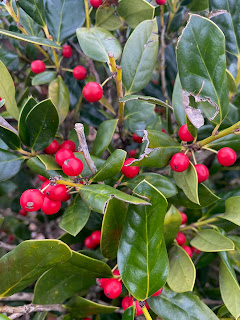
    Holly

    Holly

    Ilex aquifolium

    Cancer, Leo

    Balance, Protection 

    Holly is some 600 species of evergreen trees and shrubs that like to grow in tropical and warm areas worldwide. The plants like sun to part sun and well-drained soil. Some varieties can live to 100 years old. 

    Historically, Holly has been gathered as a Christmas decoration and has been associated with the crown of thorns on Christ's head due to the spiky leaves. 

    Holly plants are best known for their bright red berries that remain on the plants for up to 6 months and are an important source of food for birds in winter. Small mammals also eat the berries and leaves. Different varieties of holly produce berries in pink, blue, orange and white. Holly berries are poisonous to people and pets. 

    Most Holly plants are dioecious, meaning they produce either male or female flowers. Female plants rely on nearby male plants to be pollinated, otherwise they will not produce berries. Only female plants produce berries. Male plants need to be within 50 feet of a female holly plant.

    Holly is symbolic of balance - it takes a male and female plant for berries to be produced. The concept of male and female, each put on the end of a balanced scale, with provide balance with the concepts of the masculine and feminine in life. The plants have spiky leaves, which keep animals away, and they have berries that nourish birds and small animals. Again, we have concepts that when put on either side of a scale, plant protection and small mammal and bird nourishment, balance out. Holly can remind us to look at each side of an issue and to look at the balance that can be often found in the whole. And also the idea that some people can be prickly on the outside but, in balance, can be compassionate on the inside. 

    Most Hollies keep their leaves through the winter which offer protection for nesting birds. As food sources become scarce in winter, Holly is a steady food source for birds and small mammals.  

    The energetic concepts of balance and protection lend themselves to providing a solid foundation for meditation for our daily lives. Holly can be used as the base or as a starting point for a journey or meditation if you're interested in bringing a strong concept from nature into your spiritual practice. If you feel an affinity to Holly or are in a place where you feel the need for protection or of feeling safe, you can call on the spiritual energy of holly to surround you with its spiky leaves and protective energy, not allowing in anything that doesn't serve your highest good. While nestled in the protection of the branches, you can use the image of the nesting bird to spread your wings (your imagination) to reach into the higher realms. 

    Planting Holly near your home can bring the properties of balance and protection to your living space. 

    Holly can be propagated through seeds and cuttings.

    • English Holly (Ilex aquifolium) is native to Europe, North Africa and Western Asia. Plants grow 15 to 50 feet tall and up to 15 feet wide and have dark green spiny leaves. Small white flowers produce  red, yellow or orange berries.
    • American Holly (Ilex opaca) is native to Eastern and South Central United States. Plants grow 25 to 50 feet tall, with some up to 70 feet. Plants have dark green spiny leaves that have been used to make tea to treat colds. 
    • Winterberry (Ilex verticillata) is native to eastern North America. Plants grow up to 12 feet and  produce clusters of bright red berries. Also known as Michigan Holly and Black Alder. 
    • Chinese Holly (Ilex cornuta) is native to China and Korea and grows from 15-25 feet tall and 20 feet wide. It has dark green leaves and produces red berries. Plants will grow in hot and humid conditions and are drought tolerant. Also known as Horned Holly. 
    • Japanese Holly (Ilex crenata) grows up to 10 feet tall and is native to Eastern Asia. Plants grow less than 6 inches per year. 

    Holly is used as a Bach Flower Remedy to stimulate a loving nature towards others.  Holly is also available as an essential oil.


    Thursday, September 30, 2021

    Columbine

    Aquilegia 

    Taurus

    Compassion, Inner Wisdom

    Columbine blooms in the spring or early summer and continues to bloom for the next four weeks.These perennial plants like sun to part shade and well-drained soil. Columbine can be started easily from seed and, once plants are established, they are drought tolerant. Columbine also self reproduces from flower heads that go to seed.

    Columbine consists of about 70 species of plants that grow in clumps from 1 to 3 feet tall, from 1 to 2 feet wide. Flowers are bell shaped with spurs and bloom in yellow, red, orange, blue, purple, pink and white. Plants have dark green, clover-like leaves.

    Plants can easily be grown from seeds and will self-seed in the garden. Columbine can withstand extreme cold in winter (USDA Plant Hardiness Zone 3).

    The attributes of Columbine, compassion and inner wisdom, work in tandem. One must be very hardy and be able to withstand the extreme coldness in others to be compassionate. Compassion comes in as many colors as the Columbine flowers and, through example, will spread to those around you just as easily.

    Some of the species of flowers have petals that are contrasting colors: purple petals that surround inner white petals, for example. This shows us the outer shell of ourselves and the aspect of inner wisdom.  This wisdom can apply itself in different ways. Some people drawn to Columbine will know their strengths and weaknesses as their own inner wisdom. Others can also use their inner wisdom to know the base motives of others, rather like an internal radar that can see through how someone presents themselves to their true inner self. This aspect is very useful when determining if another person is acting from a compassionate perspective or whether they are motivated by money or personal power.  

    Columbine is also called European Crowfoot,Granny's Bonnet and Jester's Cap. Different varieties of Columbine are native to Asia, Europe and North America.

    The leaves and stems are used to make medicines that have been used for general stomach and intestinal issues.Through history, Columbine has also been used for other medicinal purposes. Columbine flowers are edible. The seeds and roots are toxic to people and horses.

    Columbine flowers are known for attracting hummingbirds.They also attract butterflies.The plants are resistant to deer and rabbits.

    The Latin name for Columbine, Aquilegia, is from aquila, the Latin word for eagle.The name was assigned due to the long spurs that grow beyond the flower petals that resemble the five claws of an eagle.Those drawn to Columbine may also want to explore the attributes of the eagle whose ability to soar can be combined with the attributes of compassion and inner wisdom.The number five also brings an emphasis on enhanced well-being. 

    The Latin root of the name columbine, columba, means dove. Rocky Mountain Columbine has violet petals and a white cup. It is the state flower of Colorado.  


    Sunday, September 19, 2021

    Goldenrod


    Solidago

    Gemini

    Intuition, Optimism

    Goldenrod is the name for more than 100 species that is considered both a flower and a weed. It grows quickly, reaching its full height of from 1.5 to 5 feet tall in just a couple of months and spreads aggressively. Its yellow flowers grow in clusters and bloom in late summer to fall. Goldenrod attracts butterflies and bees.

    Goldenrod is comfortable in many different growing conditions and prefers full sun for best flower producing conditions. It reproduces through rhizomes, horizontal plants roots, and by dispersing seeds in the wind. A plant produces some 3,000 seeds.   

    Goldenrod blooms in late summer and folklore has the plant associated with seasonal allergies. Because it does not produce pollen (pollination is done by insects), it is not an allergen.   

    Plants can grow up to 5 feet in height and some may need to be staked. This shows us that it's ok to accept support from those around us; we all need to stand independently and can "lean" on others from time to time. The height of the plant also suggests that it's reaching for the heavens, that those who enjoy goldenrod also have the ability to see further than those around them using intuition. The intense yellow of the flowers is reflective of the sun and the sunshine in our lives bringing us optimism. The plants spread aggressively, bringing us the idea that those people who are characteristically optimistic spread their optimism to others. People who wish to become more optimistic can reflect on the sunny nature of Goldenrod and plant Goldenrod in their garden. 

    Goldenrod has the ability to easily reproduce itself through roots and the vast number of seeds dispersed by the wind. Reproduction through roots is symbolic of those people who put out feelers, or their intuition, to sense or feel others. Those who work with the elements can connect with the wind to work with and enhance their intuition. They can also use the "seeds" of their intuition to plant optimism or broader thinking in others. 

    Goldenrod is native to North America and Europe and has spread to many other places. It is used medicinally to reduce pain and swelling and for some skin conditions. In Europe, it is used to treat urinary track inflammation. It can be used as a yellow dye.


    Saturday, December 12, 2020

    Queen Anne's Lace

    Daucus carota

    Aquarius, Cancer

    Sweetness of life, Web of life, Ancestral connections

    Queen Anne's lace produces clusters of small white flowers that resemble lace. What appears to be a single flower 3 to 5 inches across is made up of 20 to 30 single flowers, often with one purple flower in the middle.  Each of the small individual flowers has five petals. The plant is said to be named for Queen Anne of England, who pricked her finger and a drop of blood stained the white lace she was making. 

    Queen Anne's lace is a biennial plant - the first year it grows as a cluster of leaves and the second year it produces flowers, then dies. Flowers bloom for most of the summer so a single plant may have flowers in different stages of maturity. Plants are up to 3 feet tall and have leaves that look like ferns. The plant propagates by seed; one plant can produce thousands of seeds. Queen Anne's lace is an ancestor to present day carrots.

    The plant originally grew in Europe and southwest Asia and also presently grows Australia and North America. Queen Anne's lace likes sun to part shade, tolerates dry conditions and can be seen growing along roads and in open fields. It is very high in sugar. Tea made from roots has been used as a diuretic. 

    Queen Anne's lace attracts bees and butterflies. 

    Queen Anne's lace shows us that things are not always as they seem - sometimes they are so much sweeter! Are you allowing yourself all of the sweetness in life? Do you need to let go of beliefs that no longer serve you to allow the natural sweetness of life to flow more easily? Are you careful about choosing topics that make you happy or bring gratitude? The plant's roots hold the sweetness, showing us that the foundation of our lives is based on that sweetness. We are grounded in all good things and need to choose to live as beings who allow that goodness to flow to us. 

    The formation of the flowers - clusters that are all connected into a single "lace" flower formation - are a representation of the web of life.  We are all individual and are all connected to each other as part of humanity. If you are drawn to Queen Anne's lace, focus on how you look at your connections to others.  Are you nurturing your most meaningful relationships? Are you appreciative of what others bring to you? Are you too focused on what others think of you? And are you giving to others - too little or two much? Look for balance in your relationships and don't be afraid to make changes where needed to achieve balance that is fair to you.  

    The interconnectedness of the flowers of Queen Anne's lace also shows us our interconnectedness with our ancestors. The plants are wildflowers - they appear to grow everywhere in summer and are a reminder that our ancestors are around us and with us always. Our ancestors provide us with that foundation to the sweetness of life, and to assist us in our lives. Do you ever think of an ancestor and you see a favorite bird? Or a number on a license plate? Our ancestors will get our attention through a variety of means to highlight their connections to us and provide answers to any questions we have. 

    Queen Anne's lace is also called wild carrot, bird's nest and bishop's lace. 

    Jasmine

    Jasminum Cancer, Capricorn  Clairsalience, Moon Energy Jasmine grows as a flowering shrub and vine warmer areas of Europe, Asia and Africa. ...