Showing posts with label balance. Show all posts

Wednesday, May 7, 2025

Lily

Stargazer Lily

Lilium

Taurus

Balance, Stability, Unfolding

Lily is a perennial plant known for its large flowers and fragrant aroma. The trumpet-shaped flowers grow wide range of colors including white, pink, orange, red, yellow and purple, some with contrasting spots or stripe. Flowers have six petals which are often curved backward or flared out. The angel number six which is symbolic for balance. Flowers can be upright, downward-facing or trumpet-shaped, depending on variety. They can be 4 to 10 inches across.

The leaves are usually long, narrow and lance-shaped, growing in an alternate pattern along the stem. Lily stems can range from 2 to 6 feet tall (60 cm to 1.8 meters).

Lilies grow from bulbs. Lilies like full sun to partial shade and well-drained soil. Most lilies are perennial and will multiply over time. Plants can be divided every 3 or 4 years.

The number of petals, six, is predominant in the symbolism of this flower. Six is an even number and the first perfect number -- the sum of its proper divisors equals itself: 1 + 2 + 3 = 6. It is also the number of faces on a cube. Mathematically and from an angel number perspective, six represents balance and stability. People who are drawn to lilies can look at balance in their lives, work and home, material and spiritual needs, and responsibility for self and service to others. Lily also brings the energy of stability; people working with the energy of lily will find it easier to balance these areas of their lives and will be able to easily bring their lives back into balance if they focus on one area for too long. 

Lily also brings the energy of unfolding: a life path unfolding in front of you, education on topics of interest unfolding in a balanced manner, the truth of a subject or area unfolding. People working with lily understand this process; often things are revealed as a series of steps unfolding before you. Lily shows us that this is a natural process. People working with Lily know that all sides of a cube are not visible at the same time; they have the innate knowing that everything unfolds and is known in perfect timing.

Lilies are toxic to cats and mildly toxic to dogs and some livestock.

Lilies are native to temperate regions of the Northern Hemisphere, including Asia, Europe and North America.  

Daylilies are not considered Lilies as they do not grow from bulbs.

Below are some well-known types:

  • Asiatic Lilies (Lilium asiatica): Flowers are upward-facing and have no scent; earliest bloomers.
  • Oriental Lilies (Lilium orientalis): Large, fragrant flowers in bold colors; bloom later in the summer and often hang down. Native to Japan.
  • Trumpet Lilies (Lilium longiflorum hybrid): Large, trumpet-shaped flowers, often with a strong fragrance. Native to Asia.
  • Martagon Lilies (Lilium martagon): Nodding blooms (downward facing) with recurved petals. Plants are woodland-friendly. Native to Europe and Asia.
  • Tiger Lilies (Lilium lancifolium): Orange flowers with dark spots bloom from mid- to late summer. Originated in East Asia.
  • Easter Lilies (Lilium longiflorum): Produces white flowers in summer. Native to Japan.
  • Madonna Lilies (Lilium candidum): Flowers are white and bloom early in the summer.
  • Stargazer Lilies (Lilium orientalis 'Stargazer’): Produces pink and white flowers with a strong aroma. 
  • Crinum Lily
    Crinum Lilies (Crinum): Native to tropical and subtropical regions worldwide, including Africa, Asia and the Americas. Plants have strap-like leaves that can grow up to 3 feet (90 cm) in length.
  • Wednesday, October 27, 2021

    Holly

    Holly

    Ilex aquifolium

    Cancer, Leo

    Balance, Protection 

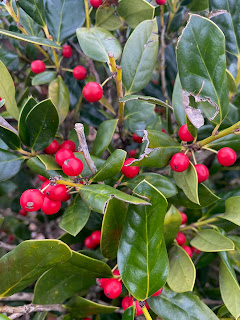
    Holly is some 600 species of evergreen trees and shrubs that like to grow in tropical and warm areas worldwide. The plants like sun to part sun and well-drained soil. Some varieties can live to 100 years old. 

    Historically, Holly has been gathered as a Christmas decoration and has been associated with the crown of thorns on Christ's head due to the spiky leaves. 

    Holly plants are best known for their bright red berries that remain on the plants for up to 6 months and are an important source of food for birds in winter. Small mammals also eat the berries and leaves. Different varieties of holly produce berries in pink, blue, orange and white. Holly berries are poisonous to people and pets. 

    Most Holly plants are dioecious, meaning they produce either male or female flowers. Female plants rely on nearby male plants to be pollinated, otherwise they will not produce berries. Only female plants produce berries. Male plants need to be within 50 feet of a female holly plant.

    Holly is symbolic of balance - it takes a male and female plant for berries to be produced. The concept of male and female, each put on the end of a balanced scale, with provide balance with the concepts of the masculine and feminine in life. The plants have spiky leaves, which keep animals away, and they have berries that nourish birds and small animals. Again, we have concepts that when put on either side of a scale, plant protection and small mammal and bird nourishment, balance out. Holly can remind us to look at each side of an issue and to look at the balance that can be often found in the whole. And also the idea that some people can be prickly on the outside but, in balance, can be compassionate on the inside. 

    Most Hollies keep their leaves through the winter which offer protection for nesting birds. As food sources become scarce in winter, Holly is a steady food source for birds and small mammals.  

    The energetic concepts of balance and protection lend themselves to providing a solid foundation for meditation for our daily lives. Holly can be used as the base or as a starting point for a journey or meditation if you're interested in bringing a strong concept from nature into your spiritual practice. If you feel an affinity to Holly or are in a place where you feel the need for protection or of feeling safe, you can call on the spiritual energy of holly to surround you with its spiky leaves and protective energy, not allowing in anything that doesn't serve your highest good. While nestled in the protection of the branches, you can use the image of the nesting bird to spread your wings (your imagination) to reach into the higher realms. 

    Planting Holly near your home can bring the properties of balance and protection to your living space. 

    Holly can be propagated through seeds and cuttings.

    • English Holly (Ilex aquifolium) is native to Europe, North Africa and Western Asia. Plants grow 15 to 50 feet tall and up to 15 feet wide and have dark green spiny leaves. Small white flowers produce  red, yellow or orange berries.
    • American Holly (Ilex opaca) is native to Eastern and South Central United States. Plants grow 25 to 50 feet tall, with some up to 70 feet. Plants have dark green spiny leaves that have been used to make tea to treat colds. 
    • Winterberry (Ilex verticillata) is native to eastern North America. Plants grow up to 12 feet and  produce clusters of bright red berries. Also known as Michigan Holly and Black Alder. 
    • Chinese Holly (Ilex cornuta) is native to China and Korea and grows from 15-25 feet tall and 20 feet wide. It has dark green leaves and produces red berries. Plants will grow in hot and humid conditions and are drought tolerant. Also known as Horned Holly. 
    • Japanese Holly (Ilex crenata) grows up to 10 feet tall and is native to Eastern Asia. Plants grow less than 6 inches per year. 

    Holly is used as a Bach Flower Remedy to stimulate a loving nature towards others.  Holly is also available as an essential oil.


    Monday, November 12, 2018

    Tulip

    Tulipa

    Aries

    Balance, Essence of Life

    Tulips are sun-loving flowers that grow from bulbs and flower in the spring in every color, including multicolor, except blue. One flower grows on each stem and flowers may be single, double, ruffled or fringed.The flower buds are known to be almost perfectly symmetrical.Tulip petals are edible raw.  After tulips flower, the stem and foliage continue to produce energy for flowers next year. The bulbs like a period of cold and dormancy to rest in between flowering.

    In Central Asia, Tulips were cultivated by Turkish growers as early as 1,000 AD. They were brought to Europe in the 16th century and Holland grew into a primary tulip grower and exporter.  Some 3,000 varieties of tulips are registered.

    Tulips bloom each spring after a period of dormancy, emphasizing the theme of rebirth.  Plant or purchase tulips or look at an object with the tulip image to bring the energy of rebirth into your home and life.

    Tulips bring a rainbow of colors to the earth, including red, pink, purple, violet, white, cream, yellow, orange, black and green. They can be used to balance chakras: using the live flowers or image (real or imagined), bring the color of the flower into the chakra you want to balance, with the intent that it be perfectly balanced. Repeat for all chakras.

    Tulips are here to remind us of the colorfulness, vibrancy and essence of life after a long winter.
    The flowers show us that after being patient we too can open in a colorful way to all that life has to offer. 

    Tulips grow in many shapes and colors, mirroring humanity on earth. Meditate with tulips for bringing balance into global situations or conditions with wide-ranging impacts.

    The plant shows us the possibility that to live simply, focused on our life purpose, without self-created drama and complications, can be colorful and joyful.

    Tulip plant leaves open and reach for the heavens, showing that we too can open and reach to the heavens with our wants and desires. The leaves form a cup – encompassing the physical manifestation of our wants and desires – holding them close and dear to us.

    Tulips bloom from bulbs each spring, thereby teaching us to enjoy these moments in the sun, and once the flower is gone, to remember we all live in the sun.

    Monday, September 17, 2018

    Poison Ivy

    Rhus radicans

    Boundaries, Balance

    Poison ivy, native to North America and known for causing itching on contact, is a vine with clusters of three leaves on the end of stems. The tip of each leaf is pointy. The plant is green in summer, and frequently turns red in fall, which makes it easier to identify. It can grow as a vine on trees and other vegetation, and can also grow as a single plant. Urushiol oil, which causes a rash and itching, is though out the plant, not just on leaves. Recovery can take from one to three weeks; a severe reaction will require medical treatment. Poison ivy is not toxic to deer, who may eat it as a source of food. Jewelweed is a natural remedy to poison ivy rash.

    How are you at setting boundaries?  Poison ivy teaches us that having boundaries is healthy, and when you allow others or events to push or exceed your boundaries, you can get very itchy.

    Poison ivy grows as vines and as plants, showing us that things toxic to us can come in any shape or size.

    Some people are very sensitive the the oil in the poison ivy plant.  Are you having reactions to what others are saying?  Know that you have your own truth and others will always have opinions and thoughts that may or may not align with who you are and how you think. Let your opinion of yourself be dominant in your experience.  

    Nature gave us a plant that causes an uncomfortable rash, and also a plant to counteract the irritating oil.  In this way, poison ivy is an example of how we can look at two sides of an issue, and how balance in our lives is important. If you're encountering poison ivy, meditate on what areas of your life could use more balance.

    Myth: A poison ivy rash is contagious.
    Truth: Human reaction is only to urushiol oil.
    Myth: Some people are very sensitive to poison ivy and some are immune to the effects of the oil.  Truth: People's sensitivity to poison ivy can change over time.

    Jasmine

    Jasminum Cancer, Capricorn  Clairsalience, Moon Energy Jasmine grows as a flowering shrub and vine warmer areas of Europe, Asia and Africa. ...