Saturday, December 12, 2020

Queen Anne's Lace

Daucus carota

Aquarius, Cancer

Sweetness of life, Web of life, Ancestral connections

Queen Anne's lace produces clusters of small white flowers that resemble lace. What appears to be a single flower 3 to 5 inches across is made up of 20 to 30 single flowers, often with one purple flower in the middle.  Each of the small individual flowers has five petals. The plant is said to be named for Queen Anne of England, who pricked her finger and a drop of blood stained the white lace she was making. 

Queen Anne's lace is a biennial plant - the first year it grows as a cluster of leaves and the second year it produces flowers, then dies. Flowers bloom for most of the summer so a single plant may have flowers in different stages of maturity. Plants are up to 3 feet tall and have leaves that look like ferns. The plant propagates by seed; one plant can produce thousands of seeds. Queen Anne's lace is an ancestor to present day carrots.

The plant originally grew in Europe and southwest Asia and also presently grows Australia and North America. Queen Anne's lace likes sun to part shade, tolerates dry conditions and can be seen growing along roads and in open fields. It is very high in sugar. Tea made from roots has been used as a diuretic. 

Queen Anne's lace attracts bees and butterflies. 

Queen Anne's lace shows us that things are not always as they seem - sometimes they are so much sweeter! Are you allowing yourself all of the sweetness in life? Do you need to let go of beliefs that no longer serve you to allow the natural sweetness of life to flow more easily? Are you careful about choosing topics that make you happy or bring gratitude? The plant's roots hold the sweetness, showing us that the foundation of our lives is based on that sweetness. We are grounded in all good things and need to choose to live as beings who allow that goodness to flow to us. 

The formation of the flowers - clusters that are all connected into a single "lace" flower formation - are a representation of the web of life.  We are all individual and are all connected to each other as part of humanity. If you are drawn to Queen Anne's lace, focus on how you look at your connections to others.  Are you nurturing your most meaningful relationships? Are you appreciative of what others bring to you? Are you too focused on what others think of you? And are you giving to others - too little or two much? Look for balance in your relationships and don't be afraid to make changes where needed to achieve balance that is fair to you.  

The interconnectedness of the flowers of Queen Anne's lace also shows us our interconnectedness with our ancestors. The plants are wildflowers - they appear to grow everywhere in summer and are a reminder that our ancestors are around us and with us always. Our ancestors provide us with that foundation to the sweetness of life, and to assist us in our lives. Do you ever think of an ancestor and you see a favorite bird? Or a number on a license plate? Our ancestors will get our attention through a variety of means to highlight their connections to us and provide answers to any questions we have. 

Queen Anne's lace is also called wild carrot, bird's nest and bishop's lace. 

Tuesday, November 24, 2020

Nasturtiums

Tropaeolum

Libra

Flourishing, Beauty

Nasturtiums are easy to grow from seed and grow easily in poor soil. They germinate quickly and grow quickly. Once established, Nasturtiums produce bright yellow, orange and red flowers will bloom all summer until the first frost. The leaves and fragrant flowers are edible and provide high levels of vitamin C. 

The plants like full sun and well drained soil. They like to be watered regularly. The plants will wilt during drought but will come back when watered.

Nasturtiums attract bees and butterflies. Nasturtiums release an airborne chemical that repels some common garden insects.The chemical also protects plants nearby.

The plants are available as spreading or climbing. The spreading (Tropaeolum minus) forms a loose mound like a bush and the climbing (Tropaeolum majus) needs support like a trellis for vines or will spread on the ground. Nasturtiums are native to Mexico, Central America and northern South America. 

The plants leaves and flowers are high in vitamin C and it has been used for respiratory care and for treating bacterial and fungal infections. It has been used for disinfecting cuts.

Nasturtiums shows us that ideas only need a place to land, not rich soil, to flourish. Ideas can flourish in any environment. The same is true for people.  Have you felt that you are not in a great environment for you?  Give yourself a chance to move ahead with your unique ideas and projects even if you are not understood and supported by those around you. You may be surprised at how quickly your ideas germinate and grow. 

Nasturtiums also bring us beauty. The vibrant flowers bring us beauty to our gardens.The chemical produced that repels insects works to retain the beauty of the plants as well as plants nearby. Nasturtiums are a reflection of our internal and external beauty and remind us of the simple beauty that is part of the soul of all life. If you're feeling less than your vibrant self, planting Nasturtiums, having a salad with the flower pedals or leaves or connecting with the energy of the plant will help to restore your image of your natural beauty and that of all life around us.

Nasturtiums are also known as Capuchina, Capucine and Indian Cress.

Tuesday, March 3, 2020

Egyptian Star Cluster

Pentas lanceolata
Egyptian Star Cluster


Vibrancy, Positive Life Changes

The Egyptian Star Cluster, also known as Pentas, bloom throughout the summer, producing clusters of vibrant red, pink and purple flowers. The star-shaped flowers have white centers and attract butterflies and bees. The plants are perennial and thrive in warm, humid climates and like full sun with well-drained soil. In cooler regions, plants are grown as annuals. The plants have dark green lance-shaped leaves.

The plants are native to Africa. Plants grow up to 3 feet tall, and in very warm regions can grow into shrubs.

Egyptian Star Cluster flowers have five petals.  The spiritual vibration of the number 5 is also important - representing personal freedom and life changes that move you in a positive direction.  These moves may be done or experienced with more passion and intensity than you observe in people around you. As the flowers attract butterflies and bees, these are jumping off points or connections to higher realms.  This may mean you're ready for a move into a more spiritual direction.

The intensity of the color of Egyptian Star Clusters as well as the long bloom period symbolize vibrancy. People who enjoy these flowers or are attracted to them may find that they are the most vibrant surrounded with other people who share their interests and passions. They will feel comfortable being the "star" attraction and others will feel attracted to their level of vibrancy.  Egyptian Star Clusters bloom all summer through to fall and the first frost, and so do people who enjoy these plants - the frost represents a cooling time when the person can go within and recharge.  It also could symbolize external forces or people who want to "cool down" an individuals vibrancy.  Ask yourself it you are allowing yourself the personal freedom to feel vibrant or if you're allowing yourself to listen to others who don't appreciate your stellar qualities.


Saturday, February 1, 2020

Lemon Balm

Melissa officinalis

Cancer, Pisces

Cleansing, Clearing

Lemon Balm is a lemon-scented perennial herb historically used to flavor food and for healing. The herb is also referred to as Melissa, the Greek word for honey bee. Lemon balm flowers attract honey bees.  Leaves of the Lemon Balm plant are used to make Melissa essential oil.

Lemon balm is grown world wide but was native to southern Europe and northern Africa.  It prefers full sunlight or part shade. Plants do not like high humidity.  Lemon Balm has bright green leaves, can grow up to 3 feet tall and blooms from June to August with white or cream colored flowers.  Plants are deer resistant.

Lemon Balm seeds are very fine and need very little dirt covering them. Germination takes place 6 to 8 weeks after planting.  Plants can also be propagated through cuttings rooted in water. 

Lemon Balm has been used to sooth digestive disorders, respiratory issues and to calm anxiety and stress.  It is used as an essential oil and tea.

Lemon Balm can be used to cleanse and clear on all levels by setting the intent that healing can take place at the "source" of the illness or distress within the body by allowing "source" of all that is to do the healing. Lemon Balm has a fragrant scent that works to help relax and uplift.  Using the scent, the essential oil or other form of the Lemon Balm leaves benefits us by assisting with relaxation and letting go that's needed to let in the healing energy.  Set your intention to direct the healing energy to clearing the source of the illness or distress.  In conjunction with clearing symptoms of illness or distress, Lemon Balm can cleanse resident symptoms and work to bring the body and mind back into a natural balance. 

Lemon Balm can be used at regular intervals for its cleansing and clearing effects to maintain general good health and well being. It can also be used in a personal ceremony to cleanse chakras, to celebrate good health and well being or to celebrate other uplifting areas of interest to you.

Common names for Lemon Balm are Sweet Balm, Melissa Balm, Heart's Delight and English Balm.

Friday, January 24, 2020

Bee Balm


Monarda


Cancer

Cleansing, Clairalience (Smell)

Bee Balm is a fragrant perennial that produces red, pink, purple and white flowers in late spring and summer. Flowers bloom for up to 6 weeks. 

The plants like full sun but in areas with very hot summers will tolerate some shade.  They also like well drained soil. The flowers attract bees, butterflies and hummingbirds.

Bee Balm is part of the mint family. The petals of the flower can be used to make tea and are edible.  The leaves can also be eaten.  It is deer and rabbit resistant.

Bee Balm is native to North American woodlands and likes moist soil that is well drained. Grown domestically, the plants grow in clumps from 1.5 to 2.5 feet in width, from 3 to 4 feet tall. Plants can be divided every couple of years in the spring or fall. Bee Balm spreads easily by seed.

Native Americans used Bee Balm as an antiseptic to treat topical infections and as a decongestant.  It is antimicrobial - a natural source of the antiseptic ingredient Thymol which was used historically for mouth infections and is used currently in some mouthwashes. Bee Balm is used for cleansing - both for calming and treating physical infections and for treating mild emotional distress.  Smelling Bee Balm is very soothing. It can also be used to make an herbal tea that has a mild mint taste, which can be calming to physical and mild emotional stresses.

Bee Balm flowers smell of orange and spice, spearmint and peppermint, with some hints of oregano. Because of the strong frangrence of Bee Balm, it is connected to Clairalience, the psychic sense of smell.  Smell connects people strongly to memories, which can be brought to consciousness for healing and story telling.

Alternate names are Scarlet Beebalm, Crimson Beebalm, Horsemint and Bergamot (Bee Balm is not used to make Bergamot tea). Oswego Tea refers to the Oswego Native Americans living near the city of Oswego in upstate New York who taught early settlers from Europe to use the plant leaves to make herbal tea.


Gladiolus

Gladiolus
Gladiolus

Leo, Virgo

Spiritual Growth, Angelic Connection

Gladiolus is a perennial known for tall (2 to 5 feet) flower spikes. The flowers are in a range of colors white, yellow, pink, lavender, rose, burgundy, coral and green. The flowers can be grown in colder regions as annuals. Flowers bloom once a year from March to May.

Gladiolus are grown from bulbs known as corms which are flatter in shape than traditional bulbs. Plants will multiply and spread from corms. Flowers bloom from 70 to 90 days after corms are planted. Plants like well drained soil and full sun.

Hummingbirds are attracted to Gladiolus.

The name Gladiolus is from gladius in Latin which means sword.  Gladiolus means little sword, and for that reason, it was associated historically with strength.

Gladiolus also brings in and emphasizes the energies of spiritual growth or blossoming into the light.  People who are becoming light workers or growing into their own awareness and intuition can find inspiration and reinforcement of their abilities with Gladiolus.  It also bring us the imagery of reaching to the heavens then blossoming, emphasizing our connection to the divine radiating from source and the divine within ourselves.

Gladiolus is also symbolic of connection with Angelic realms.  It grows in clumps of corms, reminding us of a community, and blooms in a variety of colors, reminding us of the variety of angles here to work with us. People wishing to deepen their connection to the energy of angels can use Gladiolus as part of a meditation practice or as a visual inspiration to connect to that energy and a reminder that angel energy is always present.  Specific colors can also be related to specific angels:
  • Michael - Blue - tranquility
  • Raphael - Green -healing
  • Gabriel - White - revelation
  • Jophiel - Yellow - loving thought
  • Uriel - Red - wisdom
  • Chamuel - Pink - relationships
  • Zadkiel - Purple - angel of mercy
In Chinese astrology, Gladiolus is associated with people born in the year of the monkey.


Tuesday, December 3, 2019

Iris

Iris
 
 Iris

Cancer, Virgo

Connection to source energy, Healing with color

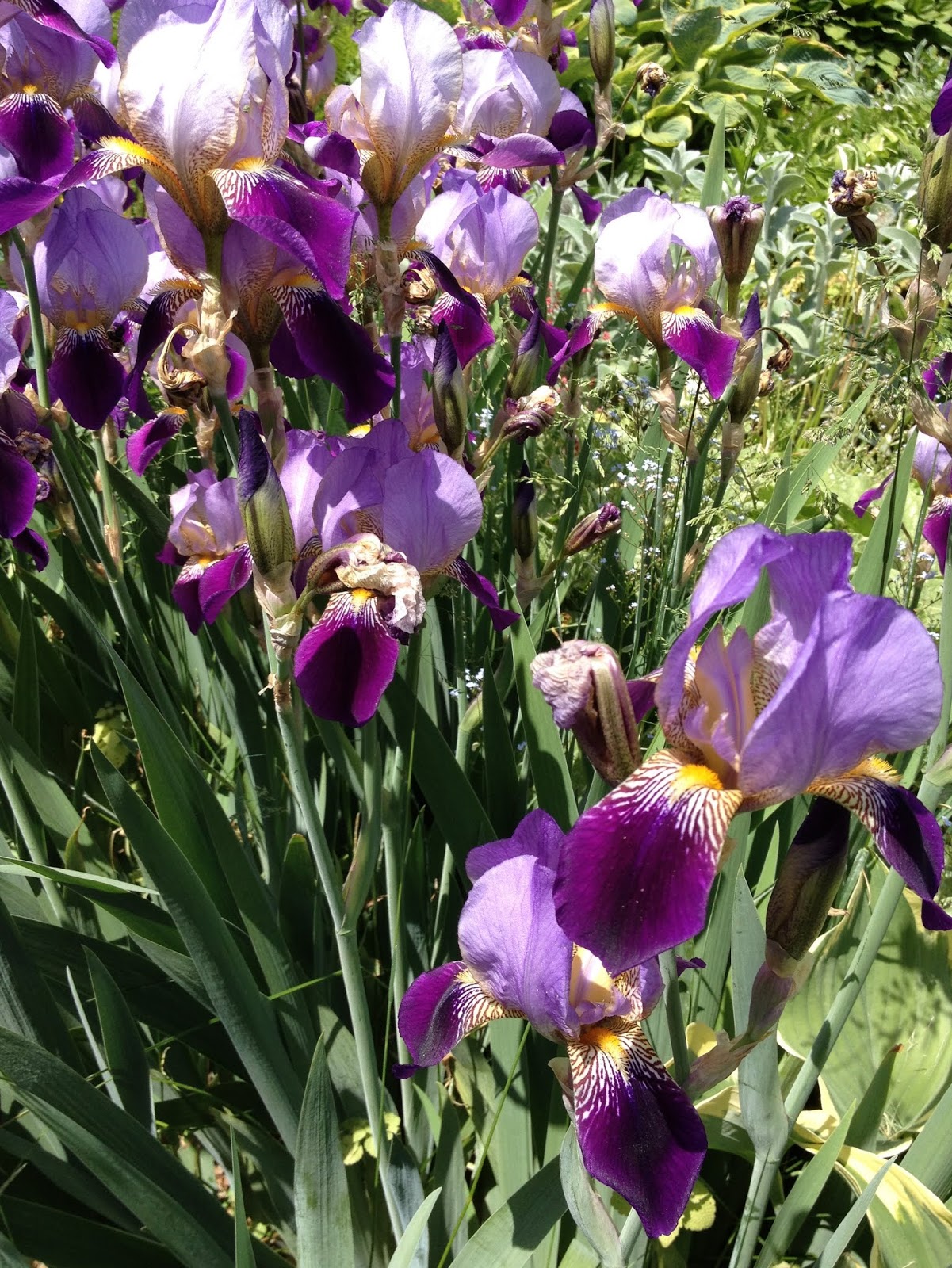
Iris are perennials that grow from 6 inches to up to 40 inches. Flowers grow on stalks and are in many colors, including blue, purple, yellow, white, pink, red, orange and brown.  Most Iris varieties have flat leaves that fan out around the stalks.

Iris roots are rhizomes, which grow at the soil surface, and produce horizontal roots and new flowering stalks for the plant. The iris plant can easily be propagated by dividing the rhizomes. Some Iris varieties are grown from bulbs. More than 60,000 cultivars (types of iris) are grown. A common name for some types of iris is "flags."

In Japan, Iris is known for its purifying energies and the flower is worn to protect the wearer.

Iris, in Greek mythology, is a goddess of the rainbow and is a messenger of the gods.  She was also known as a goddess of the sea and sky. Iris has unique capabilities related to her goddess status.  The plants receive source energy/divine energy as all living things do but what makes Iris unique is that the purpose of the plants are to to be open to receive source energy or the energy of the heavens. Iris is one of the light workers of the plant family and you can become familiar with Iris to work in partnership with the plant to leverage this unique capability. You can sit near Iris plants and absorb the energy they are receiving.  For those who practice shamanic journey, the stem or leaves of the Iris plant can be used as an energy conduit or focal point to jump into the lower world. Iris can also be used in combination with the wind as a jumping off point to the middle world.

If you are specifically drawn to Iris you can contemplate whether you could benefit from the energy Iris receives from the heavens or whether you need to be more open to receiving source energy.  You can work with the energy Iris brings in your own light worker practice, and to receive high vibration energy that you and others can use with the intent to heal.  As Iris is goddess of the rainbow, Iris will assist with healing with color.

Iris is poisonous if ingested. The plants are deer and rabbit resistant.

Iris is available in many varieties:
  • African Iris (Dietes bicolor) - likes full sun and is drought tolerant. Produces white flowers accented with yellow and blue.
  • Bearded Iris (Iris germanica) - also known as German Iris.  Many types are available with plants growing from 8 to 38 inches high. Flowers bloom in a variety of colors, depending on variety, from mid-spring to early summer and require good drainage.
  • Dutch Iris (Iris hollandica) - grows from bulbs and blooms in spring. Likes full sun and well drained soil. Popular with florists due to long stems and long lasting flowers.
  • Dwarf Crested Iris (Iris cristata) - grows in part to full shade and blooms in white, purple and blue from March to May. Clusters of leaves grow from 4 to 16 inches high with flowers 2.5 inches wide.
  • Japanese Iris (Iris ensata) - will grow in shallow standing water and poorly drained soil. Also known as the Butterfly Iris.
  • Louisiana Iris (Iris brevicaulis, Iris fulva, Iris giganticaerulea, Iris hexagona, Iris nelsonii) - five species native to Louisiana and the Gulf Coast. These plants tolerate swamp conditions, like full sun and are dormant in August and September. 
  • Siberian Iris (Iris sibirica) - blooms in late spring and early summer and will grow in poorly drained soil. Plants produce clumps of grassy leaves, and are native to Northern Italy, Turkey and Southeast Russia.
  • Walking Iris (Neomarica gracilis) - attracts bees, butterflies and birds. Grows from 10 to 36 inches high and usually has 12 leaves.


Banyan

Ficus benghalensis Pisces  Seeing Life as an Illusion  The banyan tree is a large, evergreen species of fig native to the Indian subcontinen...